
On this page (10)
- 1.The Credit Question Every South African Avoids (Until It's Too Late)
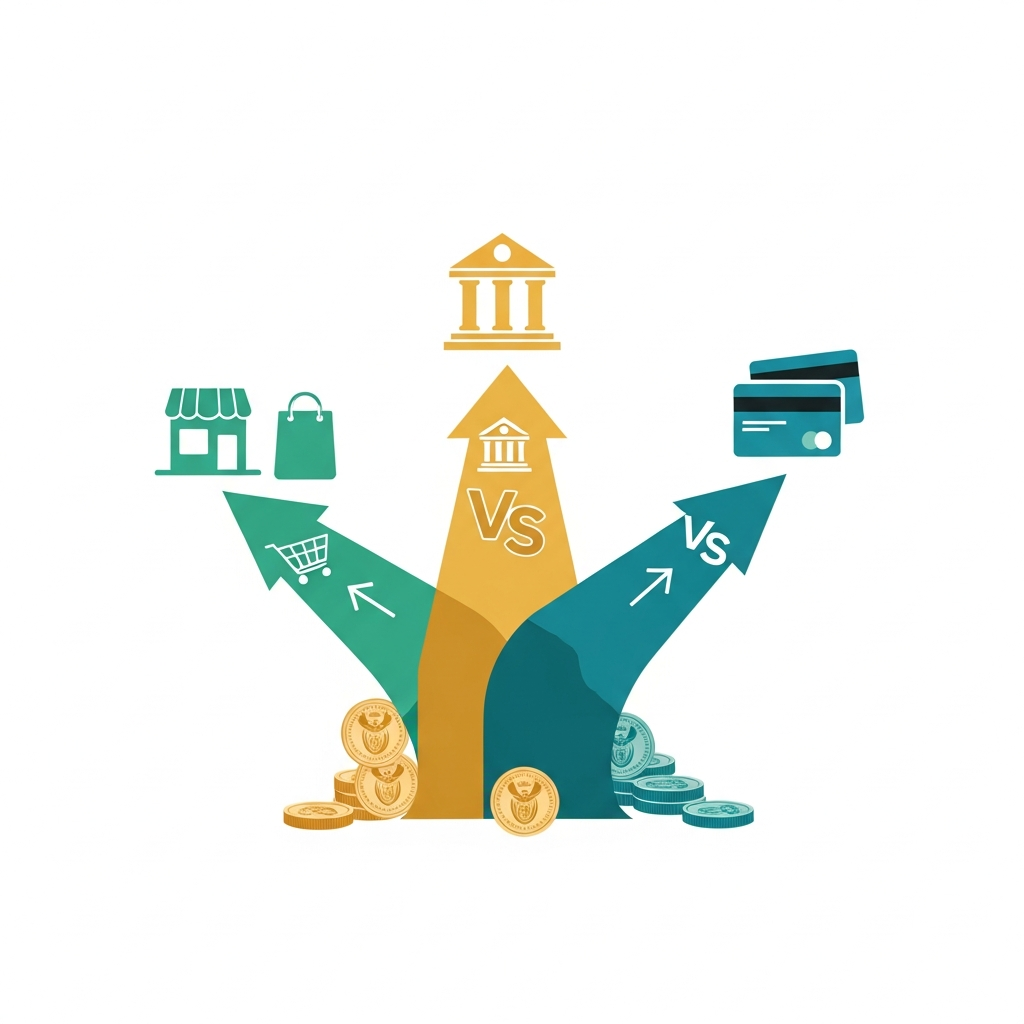
- 2.The Three Credit Products Explained (And Why They're Different)
- 3.What the Real Interest Rates Actually Are (March 2026)
- 4.The R5,000 Purchase: Where Size Matters
- 5.The R20,000 Purchase: Where Personal Loans Emerge
- 6.The R50,000 Purchase: Personal Loans Shine
- 7.The Costs Nobody Talks About
- 8.When to Use Each Product
- 9.The Consolidation Opportunity Nobody Takes
- 10.The Real Bottom Line
The Credit Question Every South African Avoids (Until It's Too Late)
You walk into Woolworths needing a winter jacket. The till staff asks: "Will you apply for a store account today?" You walk into FNB wanting a loan. Their website asks: "Why not use your existing credit card instead?" You're carrying a balance on Mr Price. You get a personal loan offer in the mail.
Three products. Three different interest rates. Three different cost structures. And almost nobody — and I mean almost nobody — actually sits down and calculates which is cheaper for their specific situation.
This is the article that does that maths for you. Real rates from real South African lenders. Real examples with R5,000, R20,000, and R50,000 purchases. And a clear answer to the question most people ask too late: "How much is this credit actually costing me?"
The Three Credit Products Explained (And Why They're Different)
Store Accounts: The Convenient Trap
A store account is credit issued by a retailer — Woolworths, Edgars, Mr Price, Truworths, Foschini, PEP, Ackermans — that only works at that specific store (or its sister brands). You get a credit limit somewhere between R500 and R20,000. You buy now, pay later.
The structure is deceptively simple. You swipe your store card. You walk out with goods. You get a monthly statement with a minimum payment. If you pay the minimum, the balance carries forward to next month. If you pay in full, you're done.
The problem? Most people don't pay in full. Most people pay the minimum.
Credit Cards: Confusingly Good and Confusingly Bad
A credit card is issued by a bank, accepted anywhere with a Visa or Mastercard logo, and comes with a credit limit (typically R5,000 to R200,000). You get a monthly statement. You have a choice: pay the full balance, pay the minimum, or pay anything in between.
Here's what makes credit cards weird: they're the cheapest credit available if you have discipline. They're the most expensive credit available if you don't.
The grace period is real. Buy something on the 1st of the month, and if you pay the full statement balance by the due date (usually 20-25 days later), you pay zero interest. Zero. This is why people who use credit cards for daily purchases and clear the balance every month get an interest-free loan every month.
Personal Loans: The Structured Option
A personal loan is a fixed amount borrowed upfront, repaid in fixed monthly instalments over a fixed term (typically 12 to 72 months). You get the money in your bank account. You can spend it on anything. Your repayment amount never changes.
This is the structure's appeal: certainty. You know exactly how much you'll pay every month. You know exactly when you'll be done.
What the Real Interest Rates Actually Are (March 2026)
Store accounts: Woolworths charges around 7.5% — significantly lower than the 22% everyone quotes. Most other retailers (Mr Price, Edgars, Truworths, Foschini) charge between 21% and 27% per annum, often at the NCA maximum. Add monthly service fees (R5 to R70) and initiation fees. The effective cost is interest plus all fees combined.
Credit cards: Major South African banks currently offer credit card rates between 15% and 23% per annum. Capitec at 16%-20%. FNB at 16.25%-22.25%. Standard Bank at 15.5%-21%. Nedbank at 15.75%-21.25%. Absa at 16.5%-22%. Add monthly card fees (R30 to R70 for basic cards). But — and this is crucial — if you pay your full balance every month, these fees are your only cost.
Personal loans: As of March 2026, the SARB repo rate sits at 6.75% with the prime rate at 10.25%. Personal loans from major banks range from 15% to 24%. Online and digital lenders (TymeBank, Fasta, and others) typically charge 18% to 26%+. There's also an initiation fee (capped at R1,207.50 for loans over R10,000) and a monthly service fee (capped at R69).
The R5,000 Purchase: Where Size Matters
You need R5,000 for an appliance or clothing. You want to pay it off over 12 months. Which credit product costs the least?
Store Account at 26% per annum
Monthly payment: approximately R475. Monthly service fee: R50. Total repaid: R6,300. Total interest and fees: R1,300.
Credit Card at 20% — With Fixed Installments
If you commit to R475/month instead of minimum payments, you'll clear R5,000 in about 12 months. Total repaid: R5,560. Total interest: R560. Significantly cheaper than the store account.
But if you make minimum payments (5% of balance or R150, whichever is higher)? It takes 40+ months. Total repaid: R7,200. This is the trap.
Personal Loan of R5,000 at 20% over 12 months
Monthly instalment: R475. Monthly service fee: R69. Initiation fee: R575. Total repaid: R6,528.
For a small purchase, the personal loan is most expensive. The initiation fee is proportionally brutal on small amounts.
Winner for R5,000
Credit card with fixed payments wins (R5,560). Store account second (R6,300). Personal loan most expensive (R6,528).
The R20,000 Purchase: Where Personal Loans Emerge
Store Account at 26% over 24 months
Monthly payment: R1,085. Monthly service fee: R50. Total repaid: R27,240. You're adding 36% to your purchase price.
Credit Card at 20% with Fixed Payments
R1,085/month clears it in approximately 22 months. Total repaid: R23,870. Nearly R3,400 cheaper than the store account.
Personal Loan of R20,000 at 18% over 24 months
Monthly instalment: R970. Monthly service fee: R69. Initiation fee: R1,208. Total: approximately R24,528.
Winner for R20,000
Credit card with fixed payments wins (R23,870). Personal loan at 18% comes close (R24,528). Store account most expensive (R27,240).
This is where comparison matters. The 2% difference between an 18% and 20% personal loan is about R1,500 over 24 months.
The R50,000 Purchase: Personal Loans Shine
For larger amounts, credit cards and store accounts won't give you the limit. Personal loans become the only viable option.
Personal Loan of R50,000 at 18% over 36 months
Monthly instalment: R1,808. Monthly service fee: R69. Initiation fee: R1,208. Total: R67,580. Total interest and fees: R17,580.
Personal Loan at 24% over 36 months
Monthly instalment: R1,970. Total: R73,612.
That 6% difference costs you R6,032. This is why comparing lenders matters. You could get offers at 18%, 21%, and 24%. The difference is real money.
The Costs Nobody Talks About
Store accounts: The minimum payment trap. A R10,000 balance at 26% with a 5% minimum payment takes more than three years to clear. You pay more than R14,000 for R10,000 of goods. Always pay more than the minimum. The credit limit upgrade trap is worse — "Your limit has been increased to R50,000!" means "Here's an invitation to spend six times what you were already spending." Most people take it.
Credit cards: The cash advance trap. Withdraw cash using your credit card and you pay 3% to 5% immediately, plus interest from day one (no grace period). On R10,000, you're down R300 to R500 before you spend it. Never use credit cards for cash withdrawals unless it's an emergency.
The minimum payment spiral is worse. A R15,000 balance at 20% with 3% minimum payments takes more than 10 years to clear. You pay more than R30,000 for R15,000 of purchases.
Personal loans: The extended term trap. A R100,000 loan over 72 months has lower monthly payments than the same loan over 36 months. But you'll pay approximately double the total interest by stretching to 72 months. Always choose the shortest term you can afford.
The credit life insurance overpayment is significant. At maximum of R4.50 per R1,000 of outstanding balance per month, a R100,000 loan costs R450/month initially. You can provide your own insurance at lower cost.
When to Use Each Product
Store accounts: Only if you need under R2,000, have no credit card, and will pay it off within one to three months. They're useful for building credit history. Otherwise, expensive.
Credit cards: Use them if you can pay the full balance every month (making them free). Use them for everyday purchases with rewards. Do not use them as revolving credit unless you're comfortable paying 15%-23% interest.
Personal loans: Use them for amounts above R10,000 where the initiation fee becomes proportionally small. Use them for debt consolidation, where combining five store accounts into one personal loan at a lower rate saves money and simplifies life.
The Consolidation Opportunity Nobody Takes
Say you're carrying Woolworths R4,000 at 7.5% (R300/month), Truworths R3,000 at 26% (R250/month), Mr Price R2,000 at 24% (R200/month), and credit card R8,000 at 20% (R400/month). Total: R17,000 across four accounts. Total monthly payment: R1,150.
Consolidate into one personal loan of R17,000 at 18% over 18 months. Monthly payment: approximately R1,040. You pay R110 less per month and clear it in 18 months instead of limping along indefinitely on minimum payments.
The catch? You have to close those accounts. Many people consolidate, then run up the accounts again because the credit limit is now "available." That's how you end up with R17,000 in original debt plus R17,000 in new debt.
Use RandCash to compare consolidation loan options from multiple lenders. Calculate the total cost, not just monthly payment.
The Real Bottom Line
Credit cards are cheapest if you have discipline. Personal loans are best for bigger amounts. Store accounts are almost never the cheapest option.
But here's what actually matters: before you use any credit, ask — can I afford the monthly payment for the entire term without destroying my budget?
If the answer is no, don't borrow. If yes, compare your options and pick the cheapest one. Two lenders can offer rates 5% to 8% apart on the same loan amount. That's tens of thousands of rands difference over the loan's life.
And if you're consolidating existing debt, treat it as a fresh start. Close the old accounts. Don't run them back up. That's how you avoid ending up right back where you started.