
The thing about saving in South Africa right now is that everyone's telling you to do it while everything around you is making it bloody difficult. Electricity up 8.76%. Fuel volatile. Bread's still expensive. Wages? Not really moving. It's easy to feel like you're fighting a losing battle.
But here's what I've learned talking to people who actually manage to save in this environment: it's not about the amount. It's about the system. You need a way to save that doesn't rely on willpower, because willpower evaporates the moment your water bill shows up.
The Reality Check
South Africa's inflation cooled to 3% in February 2026, but that headline number hides some real pain. Housing and utilities? Still at 4.8% — well above general inflation. Food's at 4.4%, with meat prices up 13.5% due to foot-and-mouth constraints. So while the headline looks good, the categories that burn through the average household budget are still punchy.
And let's not forget what's coming: from 1 April 2026, Eskom's tariffs jump another 8.76%. For monthly users, that's not a rounding error — that's real money walking out the door. Some municipalities are implementing 9% increases. This is why the energy bill conversation matters. It's not abstract. For a family using 300kWh per month, an 8.76% increase translates to roughly R200 extra per month — for a household already stretched.
Given all that, the conversation about saving changes. You're not saving in a stable economy. You're saving in a tough one. The strategies need to reflect that reality.
Automation Is Your Best Friend
Forget relying on discipline. Seriously. Set up a debit order from your salary account the day you get paid — not at the end of the month when you're scrambling. R100 a month is R1,200 a year. R200 is R2,400. Small enough that you won't feel it if it happens before you see the money.
The psychology here is crucial. Money you never touch feels like it never existed. Money you transfer manually to savings? You'll find reasons to move it back. Your kid needs shoes. The rent's tight. Suddenly it's gone. Automation removes that decision point entirely.
Use a tax-free savings account (TFSA) if you can. You can contribute up to R36,000 per year (lifetime limit R500,000), and any interest you earn is 100% tax-free. It's genuinely one of the best savings vehicles available to South Africans, and most don't even know it exists. A TFSA with a debit order means your money is growing tax-free every single month, completely invisible to you.
The Electricity Angle
Load shedding's technically over, but we're shifting from load shedding costs to tariff increase costs. Same result: your electricity bill is eating your savings potential. Here's the practical bit: your savings strategy needs to include reducing energy consumption aggressively.
- LED lighting everywhere. It's 2026, not 2016. If you're still using incandescent bulbs, you're literally burning money. Swap them out — an R8 LED bulb saves you R4-5 per month per bulb. Do all 10-15 bulbs in your home and you're saving R50-75 monthly.
- Gas or a fast cooker for boiling water. An electric kettle running twice daily adds up. A gas stove is cheaper per use and works off-grid. If you switch your morning tea and coffee to a gas kettle, you save roughly R20-30 per month.
- Hot water geyser management. A geyser blanket costs R200 and saves maybe R100-150 a month. Payback period: two months. After that, it's pure savings. Wrap your pipes too — another R100 investment, another R30/month savings.
- Solar for backup or supplementary. If you can afford it, even a small solar panel system and battery can offset part of your bill. Prices have come down dramatically. A 3kW system with 5kWh battery might cost R30,000-40,000 but saves R300-400 monthly. Payback period is now 7-10 years instead of 15, which is reasonable for a 20-year lifespan asset.
Every rand you shave off the electricity bill is a rand that can go into savings. It's not sexy, but it works. And it compounds.
The Food Inflation Workaround
Meat's up 13.5% because of the foot-and-mouth disease supply crunch. That's painful if your family eats meat three times a week. But it's an opportunity: cheaper proteins exist. Eggs are stable. Canned beans are affordable and nutritious. Lentils. Chickpeas. A protein-heavy vegetarian meal costs half what a steak-heavy meal costs, and it's not some deprivation scenario. It's just different eating.
The math is brutal but simple: a 500g piece of meat at current prices runs you R80-120. A can of beans costs R12 and delivers more protein per serving. A dozen eggs costs R60 and gives you 12 protein sources.
If you've got space — even a small balcony or corner of a garden — a vegetable garden pays back in three months. Spinach, tomatoes, herbs, lettuce. These aren't luxury crops. They grow easily in South Africa. A tomato plant costs R15 and produces tomatoes for six months. That's genuinely insane value.
Grow your own herbs (parsley, basil, coriander) and you're saving R20-30 per week just on the small stuff you'd buy at Woolies. In a year, that's R1,000-1,500 from a R50 investment in seeds. It actually works.
The Coins Jar Isn't a Joke
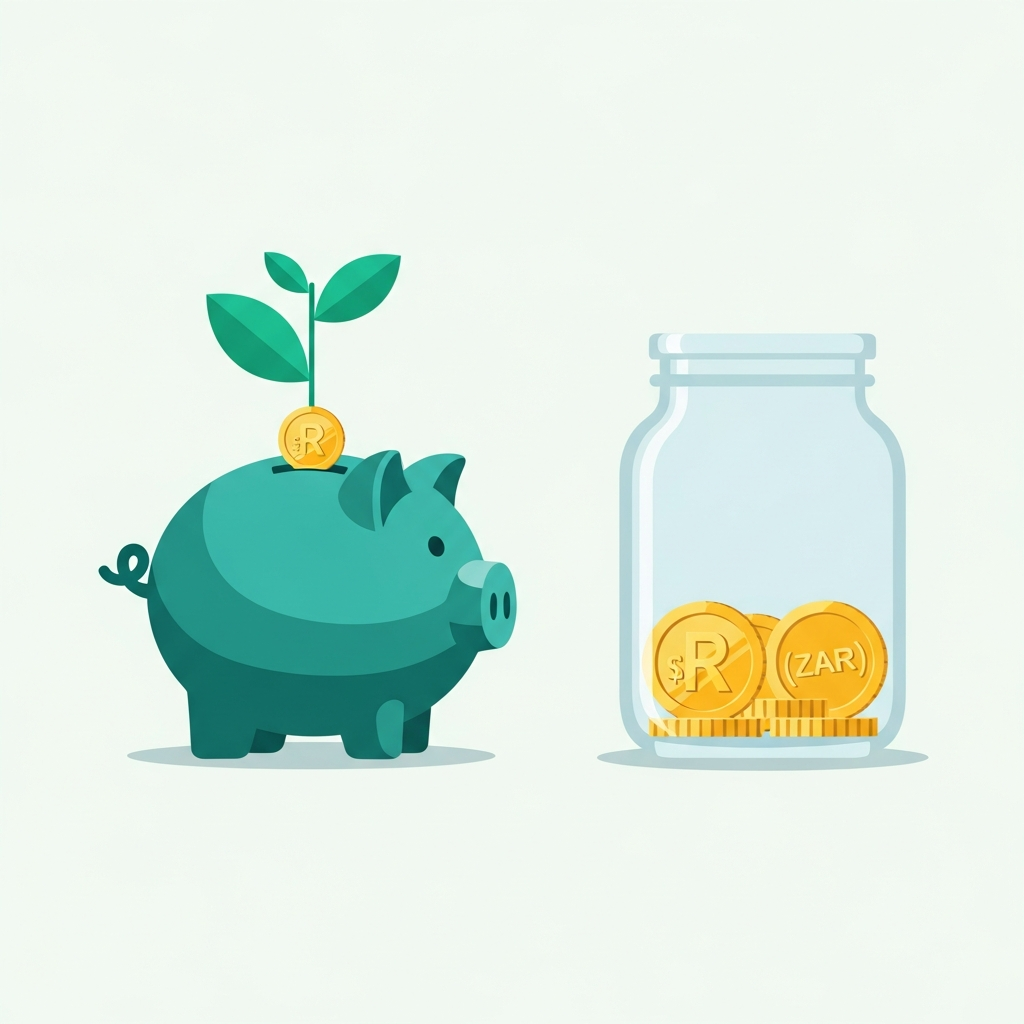
I know, I know. It sounds primitive. But it works. Put your loose change in a jar. When the jar's full, bank it. Most South Africans find R500-1,000 after six months. Don't underestimate the compound effect of "invisible" money. It's psychological, sure, but psychology is half of personal finance.
Better: use round-up savings if your bank offers it. Some apps and banks offer this feature — every transaction rounds to the nearest rand, and the difference goes to savings. If you spend R47.50 on groceries, R2.50 gets saved. It feels like nothing in the moment. Over a month of daily transactions, it's R50-100 you didn't miss.
Combine this with your R100 automated TFSA contribution and suddenly you're saving R150-200 per month without really thinking about it.
The Windfall Rule
At least half of any unexpected money should go to savings. Tax refunds, work bonuses, money your aunt gives you for your birthday — enforce the rule. You can spend the other half guilt-free, but half goes to the account.
This is harder than it sounds because every cent feels needed. But if you get a R2,000 bonus and it disappears into your daily expenses, nothing changes. If R1,000 of it goes to a savings account, in five years you've built R5,000+ just from bonuses. Add interest on that and you're looking at closer to R6,500.
People don't become savers by getting rich. They become savers by implementing small rules and sticking to them. It's not glamorous. It's boring. That's why it works.
Where to Keep It
Don't keep your savings in your main transaction account. You will spend it. Friction is your feature here. Options:
- Separate savings account with a different bank. If accessing your savings requires a trip to another bank or a five-minute process, you'll think twice before dipping in. This is intentional.
- 32-day notice deposit account. Better interest rates than a savings account, and the "notice" requirement means you can't access it instantly. Capitec and FNB both offer these. You sacrifice speed for rate.
- Money market fund. Slightly better returns, easy access (24 hours), and your money stays reasonably liquid. If an emergency hits, you're not trapped with 32 days' notice. Monthly interest payouts keep you psychologically engaged.
The interest won't make you rich, but in a TFSA or money market, your R100/month becomes R1,200 in year one. Add interest (currently around 5-6% on money market funds), and you're looking at R1,200 plus maybe R30 interest. Small, but real. Year two is R2,400 plus compound interest. It's a slow build, but it builds.
The Real Conversation
Saving in a tough economy isn't about cutting every corner and becoming a hermit. It's about making small, sustainable changes that add up. Reducing your electricity bill by R100-150. Growing herbs. Eating cheaper proteins. Putting away R50-100 in a TFSA. Round-up savings on your daily transactions. Building an emergency fund for when things go wrong.
None of these are dramatic. All of them, combined, create a real buffer. You're not saving R1,000 a month — you're building through micro-moves. That's how real people save in real tough economies.
If you're facing unexpected costs or emergencies, you can compare emergency loans and personal loans to cover financial shocks. But the better play is to have savings so you don't need them at all. Start now. Start small. The economy isn't getting easier, and you can't control inflation or electricity tariffs — but you can control how much of your income disappears into consumption versus how much stays with you. That's the game.