
Right so it's April 2026 and I've been meaning to sit down and write this for a few weeks. Every time I open the news app there's something else going on — rand slipping, petrol going up, SARB doing nothing, Joburg traffic at 7am like it's 2019 again. So here it is, a proper ground-level take on where SA is right now.
Not a Bloomberg piece. Not a panel of economists. Just what it actually feels like to be here, navigating this.
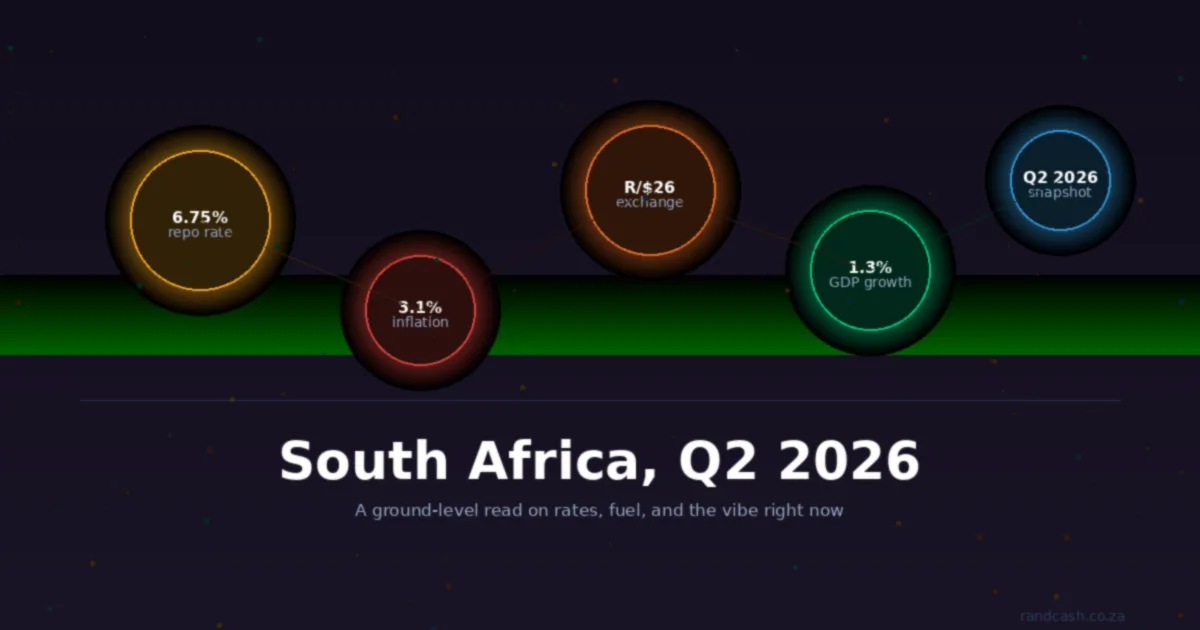
Let me start with the number everyone's been watching: the repo rate is sitting at 6.75%.
SARB held again at the March meeting. Two pauses back to back now. The thing is, you could see it coming — they flagged the Middle East situation as the main worry, and they're not wrong. Oil at around $110 a barrel has done a number on our fuel price, which is up over 18% year-on-year. That's not a small number. That's the kind of inflation that hits people before they even get to the first pay slip of the month.
There were guys in the market expecting two cuts in 2026. That's down to one now, maybe later in the year if things stabilise. If you're sitting with variable rate debt, eish — the relief is coming slower than anyone wanted.
The headline inflation number is 3.1% as of March. Inside the SARB's target band. Sounds fine on paper.
But here's the thing about South African inflation — it's not evenly distributed. The 3.1% is an average. What's actually eating people is fuel and electricity and food. Your middle-class Sandton household might be just about managing. The household in Soweto or Khayelitsha or Mitchells Plain? Different story entirely. The rand at around R26 to the dollar means imported goods keep creeping up, quietly, without anyone making a big announcement about it.
And petrol. Let's talk petrol. Almost every small business in this country has petrol somewhere in its cost structure — the bakkie that does deliveries, the spaza owner getting stock, the plumber driving between jobs. When fuel runs 18% hotter than last year, that filters into prices everywhere. It just takes a few months to show up visibly.
GDP growth for 2025 came in at about 1.3%. Budget 2026 was described — with some optimism — as positioning SA "on the cusp of rapid growth." I'll believe it when I see the load shedding stay off and the rail actually move freight.
To be fair — and I'm trying to be fair here — load shedding genuinely has improved. The days of Stage 6 feel like a distant nightmare. Eskom has had stretches of stability that a year ago would have seemed impossible. That's real. Businesses that invested in solar and inverters during the dark days are now sitting pretty; the ones that didn't are catching up. Either way, at least the production side of the economy isn't getting hammered at 2am by an unannounced outage anymore.
But "not load shedding" is a pretty low bar for an economy that wants to grow at 3% or 4%. Infrastructure is still creaking. Transnet is still a mess. Water in parts of Joburg and Pretoria is — ag, let's not even go there.
The GNU is holding together. Barely, at times, but it's holding. ANC and DA sharing a cabinet was a thing people genuinely couldn't picture two years ago, and here we are. The political noise is constant but the rand hasn't gone into freefall, which, honestly, is not nothing. Political stability — or at least the appearance of it — has been doing some work for investor sentiment.
Whether that translates into actual fixed investment into productive things? That's a slower story. But the mood among the business people I talk to is cautiously optimistic in a way that it wasn't in 2023 or early 2024. Not popping champagne. But not panicking either.
Consumer credit is interesting right now. With the repo where it is, prime is at 10.25%. Personal loan rates are running 15% to 28% depending on your credit profile and who you're borrowing from. That's meaningful money.
But here's what I'm seeing: people aren't stopping borrowing. They're borrowing smarter — or at least more carefully. The NCA has been doing its job of filtering out the worst lending behaviour. The mashonisas and the 30%-a-month store accounts still exist but people are more aware. The conversation around responsible borrowing has actually shifted in the last couple of years.
Where I'm watching with one eyebrow up is debt service ratios. When rates were at 7% repo and people took out big bonds and vehicle finance, those repayments looked manageable. Now sitting at 10.25% prime, some of those households are stretched. Not necessarily defaulting. But stretched. The debt consolidation conversation is real for a lot of families right now.
Property is a weird one at the moment. Cape Town is still Cape Town — expensive, foreigners buying, sectional titles in the Winelands going for numbers that make your eyes water. Joburg has pockets doing well and pockets doing nothing. The Atlantic Seaboard might as well be in a different country from, say, parts of the East Rand.
Distressed sales are still out there. People who bought at the peak of the low-rate era and now can't afford the monthly payment at current prime. For buyers with cash or access to finance on reasonable terms, there are deals. Not everywhere. Not as many as 2020. But they exist if you're moving quickly.
The practical takeaway for Q2 2026? I'd frame it this way:
If you're in debt, particularly at variable rates, now is not the time to be relaxed about it. The cut everyone was hoping for got pushed. Keep paying down what you can. If you've got multiple accounts at high rates, look at consolidating them — even a couple of percentage points saved on a R100,000 balance matters over 24 months.
If you're running a business, the fuel cost pressure is not going away fast. Price it in now. Don't absorb it and hope oil comes back down — it might not.
If you're a saver, the high-rate environment means decent returns on fixed deposits and money market funds. Actually shop around. Some of the smaller banks and platforms are paying meaningfully better than the big four right now.
And if you're watching the rand and thinking about big purchases — vehicles especially — the exchange rate exposure on imported components is built into prices already. Don't wait for some imagined "when the rand strengthens" moment to make a call on a decision that makes sense today.
Look, Mzansi is not an easy place to navigate financially right now. It's never been easy, honestly. But the mood feels different from the depths of 2023. The lights are on. The GNU is standing. The rate cycle has peaked even if cuts are slow coming.
The people who come out of this period well will be the ones who kept their heads, managed their debt carefully, and stayed ready to move when something lekker showed up. Same as it always was.
That's my Q2 read. Not economic forecasting — just what it looks like from down here on the ground.