
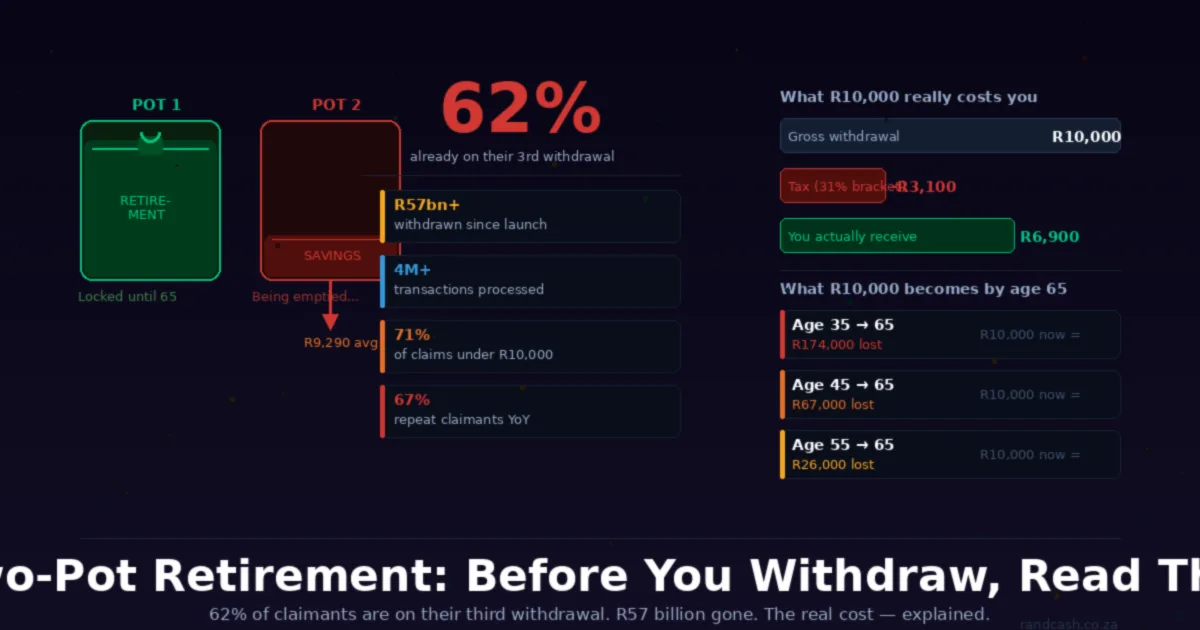
Since September 2024, South Africans have withdrawn more than R57 billion from their savings pots. More than four million transactions. And the number that should stop you in your tracks before you open the app: 62% of people claiming in March 2026 were doing so for the third time.
This is not what the two-pot system was designed for.
The system was introduced to solve a specific problem: South Africans were resigning from jobs or taking other drastic steps just to access their retirement funds in a genuine crisis. The savings pot — one-third of future contributions — was meant to be that safety valve. An emergency exit for real emergencies. What the data shows instead is that for a large and growing share of the people using it, the savings pot has become a quarterly top-up. A slow bleed on a retirement that was already under pressure.
The average withdrawal in March 2026 was R9,290. In September 2024, when the system launched, it was R12,666. The declining average is not good news — it suggests the pots are being drawn down and there is less left to take, not that people are being more disciplined. And 71% of all claims were for amounts under R10,000. These are not medical emergencies or once-in-a-decade crises. These are people bridging a month. Covering a shortfall. Servicing debt they couldn't afford this cycle.
Sixty-seven percent of people who claimed in the 2025 tax year submitted a claim again in 2026. One third are already on their second withdrawal. Nearly two-thirds are on their third.
There is a pattern here. And the pattern has a cost that most people have not fully calculated when they open the app.
The first cost is tax — and it is immediate, unavoidable, and often larger than people expect.
Savings pot withdrawals are not taxed like retirement lump sums, where the first R550,000 is tax-free. They are added to your annual taxable income and taxed at your marginal rate. If you earn R380,000 a year and withdraw R10,000, that R10,000 is taxed at your top marginal rate — which at that income level is 31%. You withdraw R10,000. You receive roughly R6,900. SARS takes the rest before the money hits your account.
For higher earners the numbers are worse. On a R400,000 annual salary, a R50,000 withdrawal costs approximately R15,500 in tax — you receive R34,500. The withdrawal is compulsory, which means you cannot spread it across tax years or time it to reduce the hit. SARS collects it when you claim.
Most people do not factor this in when they decide the withdrawal is worth it. They see R10,000 going in and R6,900 coming out and treat the R3,100 as an acceptable cost. But that calculation is only half complete.
The second cost is time — and this one is invisible until you are 65 and it is too late to undo.
Retirement savings compound. Money left invested for 30 years at a reasonable long-term return of roughly 10% per annum grows to approximately 17 times its original value. R10,000 withdrawn today by a 35-year-old is not R10,000 gone — it is approximately R174,000 not present at retirement. A 45-year-old loses roughly R67,000 in future value. Even a 55-year-old sacrifices around R26,000 in compounded growth by taking R10,000 out now.
These numbers are not alarmist projections. They are standard compound growth calculations using rates that South African retirement funds have historically delivered over long periods. The money you leave invested works for you. The money you withdraw stops working the moment it leaves the fund.
When 62% of current claimants are on their third withdrawal — and the average is under R10,000 — the cumulative retirement cost of that behaviour, at the population level, is staggering. Individual savings pots are being emptied not in one dramatic crisis but in a series of modest, seemingly manageable drains.
There is a harder conversation underneath all of this, and it is worth having directly.
For many of the people making these withdrawals, the choice is not really “retirement savings vs. a holiday.” It is retirement savings vs. keeping the lights on. The same cost-of-living pressures that are driving the debt crisis — electricity up 165% in a decade, wages lagging inflation by 20 percentage points — are also the reason people are pulling from the savings pot. They have no other buffer. The emergency fund does not exist. The credit is maxed. The savings pot is the only accessible liquid asset they have.
That context does not make the withdrawal the right choice. But it explains why telling people to “just leave the pot alone” is not always realistic advice.
What is worth saying, clearly, is this: if you are withdrawing from the savings pot to service existing debt — personal loans, credit card arrears, store accounts — you are solving a symptom, not the problem. The debt will rebuild. The savings pot will shrink. And at some point, the pot will be empty and the debt will still be there. This is the cycle that the data is showing in real time.
So when does a savings pot withdrawal actually make sense?
Genuinely once-off, non-recurring crises with no cheaper alternative: a medical emergency where no insurance coverage exists, an eviction that cannot be stopped any other way, a school fee deadline that would cost a child their place. The system was designed for exactly these moments. A single withdrawal, used to resolve a specific problem that cannot be deferred.
What it is not designed for — and what the pattern of repeat withdrawals shows — is managing chronic cash flow shortfalls. If you are regularly short by R8,000 to R10,000 a month and covering it from the savings pot, the pot is not solving your problem. It is delaying a reckoning while simultaneously dismantling your retirement.
Before you submit the claim, ask yourself two questions. First: is there a registered lender who could bridge this specific gap at a lower long-term cost than permanently removing compounding capital from your retirement? Second: if you withdrew last quarter too, what has changed about the underlying shortfall — and if nothing has changed, what will be different next quarter?
If the honest answer to the second question is “nothing,” the savings pot is not the solution. It is a delay mechanism with a retirement-sized price tag attached.
R57 billion. Four million transactions. Sixty-two percent of claimants on their third withdrawal. These numbers describe a country under financial pressure — that part is real and deserves to be acknowledged. But they also describe a pattern of behaviour that will compound quietly for the next twenty years and arrive as a retirement crisis for millions of South Africans who made decisions that felt necessary in the moment.
The savings pot is yours. You are entitled to access it. Just be honest with yourself about what it costs — and whether the alternative is actually worse.
If your monthly shortfall is driven by debt repayments consuming too much of your income, read our guide on debt review in South Africa and whether restructuring your debt is a better long-term option. If you need to bridge a specific short-term gap, compare registered lenders before touching your retirement savings — a short-term loan at a known rate may cost less in the long run than permanently removing compounding capital from your fund.
— Romans