
South Africa is a car country. The public transport system in most cities outside Cape Town is either nonexistent, unreliable, or genuinely dangerous depending on where you live. Getting to work, getting the kids to school, running a side hustle — almost all of it requires a vehicle. So when people talk about vehicle finance here, they're not talking about a luxury. They're talking about access to income.
Which is exactly why it's worth understanding how it works before you walk into a dealership and get swept up in the moment.
Vehicle finance in South Africa typically takes one of two forms. The most common is hire purchase (also called instalment sale) — you take possession of the car immediately, make monthly repayments over an agreed term, and legally own it outright once the last payment is made. The bank or finance house holds the title deed in the interim.
The second is a lease, where you essentially rent the vehicle for a fixed period and hand it back at the end. Monthly payments are lower because you're not buying the asset, but you build no ownership and have mileage restrictions. Leases are more common in the corporate and fleet space than in personal finance.
Most South Africans buying a car for personal use are looking at hire purchase. That's what we'll focus on.
The deposit is where the conversation starts, and where many people make their first mistake.
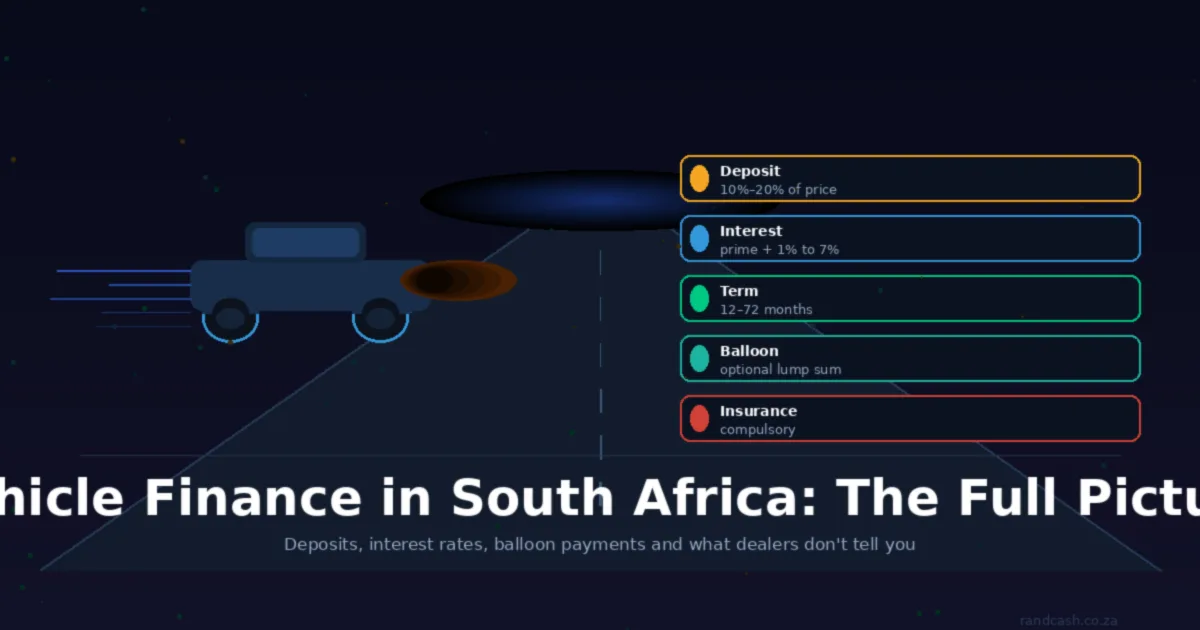
Technically, some finance deals require no deposit at all — 100% finance is available, especially from dealerships running promotional offers. Sounds attractive. The problem is that 100% finance means you're borrowing the full purchase price, which means maximum interest over maximum time. And because cars depreciate the moment they leave the lot — roughly 15% to 20% in the first year — you can quickly end up in a position where you owe more than the car is worth. That's called being "underwater," and if the car gets written off or stolen and your insurance payout doesn't cover the outstanding balance, you're paying for a vehicle you no longer have.
A deposit of 10% to 20% of the purchase price meaningfully reduces this risk. It lowers your monthly repayment, reduces the total interest you pay over the term, and provides a buffer against depreciation. If you can put down a deposit, put down a deposit. It's almost always worth delaying the purchase to save for one.
The interest rate on a vehicle finance deal is quoted as prime plus or minus a margin. With prime currently sitting at 10.25%, a "prime plus 2%" deal means you're paying 12.25% per annum on the outstanding balance.
The margin — how many percentage points above or below prime you qualify for — depends almost entirely on your credit score and income stability. Someone with a strong score and clean repayment history might get prime minus 1% from a bank. Someone with a patchy history might be offered prime plus 4% or more from a dealership finance desk. That difference, spread over 60 months on a R200,000 vehicle, can easily amount to R30,000 to R50,000 in additional interest paid.
This is why your credit score matters before you shop for a car, not after. Check it. Clean up whatever you can. Even a few months of deliberate credit repair before applying for vehicle finance can shift your rate meaningfully.
The term is how long you take to repay. Vehicle finance in South Africa typically runs 12 to 72 months — one to six years. Longer terms mean lower monthly payments but significantly more total interest paid. A R250,000 car financed at 12% over 72 months will cost you materially more in interest than the same car financed at the same rate over 48 months — even though the monthly payment feels more comfortable.
The temptation to stretch the term to make the monthly number look manageable is real, especially when a dealership's finance person is presenting you with options. Resist it where you can. Run the total cost calculation, not just the monthly figure. There are free vehicle finance calculators online — use them before you sit in that chair.
Then there's the balloon payment, which deserves its own paragraph because it's the thing that surprises the most people.
A balloon (sometimes called a residual value) is a lump sum that sits at the end of your finance term. Instead of repaying the full vehicle value across your monthly instalments, you repay a portion of it monthly and defer a chunk — typically 20% to 30% of the purchase price — to the final payment. This dramatically reduces your monthly instalment. It also means that on the last month of your agreement, you owe a large lump sum. You either pay it in cash, refinance it into a new loan, or trade the car in (hopefully for enough to cover it).
Balloon payments aren't inherently bad. For someone who knows they'll trade up every four years and plans accordingly, a balloon makes sense. For someone who finances a car with a balloon and then arrives at month 60 without a plan, it's a nasty surprise. Know what you're agreeing to before you sign.
A point that often catches people off guard: comprehensive insurance is compulsory when financing a vehicle in South Africa. The bank holds the asset and requires it to be insured against theft, accident and write-off for the duration of the finance agreement. This is not optional and it adds meaningfully to your total monthly cost of ownership.
Before you commit to a vehicle purchase, calculate the full monthly cost: instalment + insurance + fuel + maintenance + tyres. The instalment is often the number people focus on, but it's rarely the biggest chunk of what a car actually costs to run.
New versus used is a question worth thinking through carefully.
New cars come with manufacturer warranties, known service histories, and the knowledge that nothing has been hidden or bodged by a previous owner. They also depreciate fastest in the first two to three years, which means the person who buys a three-year-old car gets to sidestep that depreciation curve entirely. A well-chosen certified pre-owned vehicle with a balance of the manufacturer warranty can be a significantly better financial decision than a new entry-level car at a similar monthly repayment.
Used cars from private sellers can be cheaper still but carry more risk — especially on the mechanical side. If you go the private route, budget for a pre-purchase inspection by an independent mechanic. R500 spent on an inspection can save you from buying someone else's engine problem.
One more thing: don't only use the dealership's finance desk.
Dealerships earn commission on the finance they place. That doesn't make them dishonest, but it does mean their incentive is not always aligned with getting you the best possible rate. Before you sign anything at the dealership, get a pre-approval from your own bank — Capitec, African Bank, Absa, FNB, Nedbank — and use that offer as a baseline. If the dealer can beat it, great. If not, use your own bank's pre-approval. The process takes a day or two but can genuinely save you a significant amount over the life of the deal.
Vehicle finance is one of the biggest financial commitments most South Africans make outside of a home loan. It deserves the same level of careful thinking. The car you drive affects your daily life in a real way — so does the repayment you're locked into for the next five years.
Do the maths. Check your credit. Shop the rate. Then enjoy the new car smell.
If you want to understand the interest rate environment before you apply, read our piece on how the repo rate affects your loan. And check how to improve your credit score if you want to strengthen your rate before approaching any lender.
— Romans