
Every year, somewhere around January, a version of the same conversation happens in hundreds of thousands of South African homes. The matric results are out. The university acceptance letter arrived. Everyone is proud, everyone is excited — and then someone asks the question that turns the room quiet: how are we going to pay for it?
Higher education in South Africa is expensive. A year at a public university easily costs R50,000 to R120,000 once you factor in tuition, accommodation, meals and textbooks. Private institutions cost significantly more. And the gap between what families can afford and what studies actually cost has produced a generation of students navigating a complicated, sometimes heartbreaking, funding landscape.
This is the honest version of that landscape — what's available, how it actually works, and what to do when the first option doesn't come through.
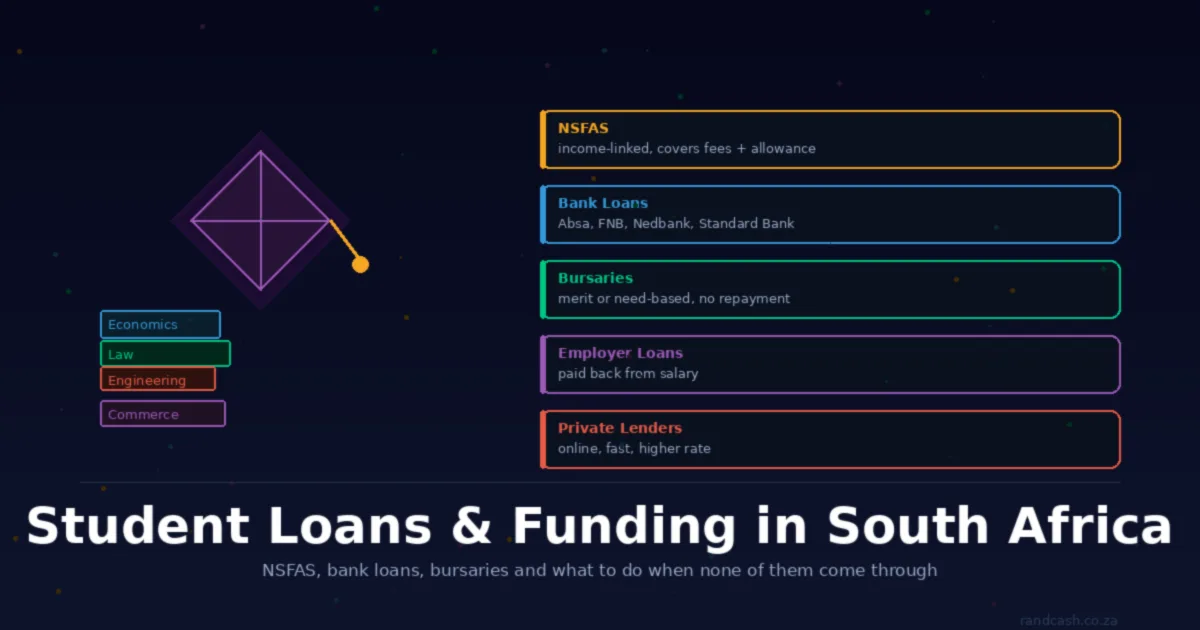
NSFAS — the National Student Financial Aid Scheme — is the first port of call for most South African students, and for good reason. If you qualify, it's the best deal available: a combination of bursary and living allowance that doesn't need to be repaid in the traditional sense.
NSFAS covers students at public universities and TVET colleges whose combined household income falls below R350,000 per year. Students from households earning under R122,000 qualify for a full bursary. Between R122,000 and R350,000, a sliding scale applies. The funding covers registration fees, tuition, accommodation (capped), and a monthly living allowance for food and transport.
The catch — and there is always a catch — is the administration. NSFAS has had well-documented challenges: delayed payments, incorrect disbursements, students going hungry while waiting for funds that are technically approved but not yet transferred. If you're applying for NSFAS, apply early, keep copies of every document you submit, follow up in writing, and have a backup plan for the first month or two of the academic year while the system catches up. This is not pessimism; it's preparation.
Also important: NSFAS support continues only if you pass your modules. If your academic performance drops below the minimum progression requirements, funding can be suspended. Know the terms before you assume funding is guaranteed year on year.
If your household income puts you above the NSFAS threshold, you're in what people in the sector sometimes call the "missing middle" — too well-off for NSFAS, not well-off enough to write a cheque for university fees without flinching. This is where bank student loans come in.
Most of the major South African banks offer student loans: Absa, FNB, Nedbank and Standard Bank all have products. The structure is typically that the loan covers tuition (paid directly to the institution) and sometimes a portion of living costs. Repayment begins after graduation, usually with a grace period of between 6 and 12 months before the first instalment is due.
The interest rate on bank student loans is variable, linked to prime — currently 10.25%. Interest usually accrues during the study period even though you're not repaying yet, which means by the time you graduate, the outstanding balance is higher than what was originally borrowed. This is important to understand upfront. A R150,000 loan at prime plus 2% over four years of study, with interest capitalising, becomes meaningfully larger by graduation day.
Most bank student loans require a surety — typically a parent or guardian who co-signs and is liable for the debt if the student doesn't repay. If you're the parent being asked to sign surety on a student loan, read what you're signing. It's your debt too if things go wrong.
Before a loan, always exhaust bursaries. A bursary is money you don't have to repay. Some are needs-based, some are merit-based, some are both. South African companies, government departments, and professional bodies offer thousands of bursaries every year — and many of them go unclaimed simply because students don't know they exist or apply too late.
Mining companies, law firms, engineering firms, banks, and state-owned enterprises all run active bursary programmes, often tied to a commitment to work for them for a defined period after graduation. The commitment is worth reading carefully, but if the alternative is R200,000 in debt, the trade is often worth it.
The government also runs bursaries through departments like the Department of Social Development, Health, Basic Education and others. NSFAS itself has evolved to include bursary components for qualifying students. University financial aid offices are the starting point — make an appointment with them before you apply for any loan.
For students who don't qualify for NSFAS, don't have a surety for a bank loan, or need top-up funding beyond what's been approved, there are private lenders and specialist student finance providers.
Companies like Fundi (formerly Old Mutual Finance) specialize specifically in education finance and offer more flexible structures than traditional banks — including options for students without a traditional income-earning surety. The rates are typically higher than bank student loans, but the accessibility is better.
Online personal loan providers are another route for smaller funding gaps — covering a textbook shortfall, paying a registration fee while waiting for formal funding to come through, or bridging a month when the NSFAS disbursement is delayed. These are short-term solutions, not study finance in the traditional sense, but they exist and they're legitimate when used carefully. Check that any lender is NCA-registered before you borrow from them and read the interest rate and total repayment figure before signing anything.
What does life look like on the other side of a student loan? It's worth thinking about before you borrow, not after.
South Africa has a graduate unemployment problem that nobody in the higher education sector likes to talk about loudly. A degree significantly improves your employment prospects on average, but average is not a guarantee. The assumption that you'll graduate, get a job, and start repaying comfortably within 12 months is an assumption — not a plan.
Before you take on student debt, have a realistic conversation about the graduate employment rate in your specific field. An engineering or medical degree from a reputable institution carries very different employment risk than certain humanities degrees from institutions with lower graduate outcomes. That's not a statement about the value of education — it's a statement about debt serviceability, which is what matters when the repayment starts.
If you're borrowing R200,000 to fund a degree, and your first-year graduate salary in your field is typically R180,000 per annum, the maths on repayment is tight but manageable. If that first-year salary is R80,000, the maths is very different. Know the numbers before you commit.
A few practical things worth knowing that most people learn too late:
Your credit score starts the moment you take out a student loan. Every payment you make (or miss) on that loan is building your financial reputation before you've even properly started your career. Take it seriously from the first month.
If you hit financial difficulty after graduation — job loss, illness, a gap between contracts — contact your lender before you miss a payment, not after. Banks have hardship provisions and payment holiday options that are much easier to access when you engage proactively.
NSFAS bursary recipients who graduate and go on to earn above the minimum income threshold are expected to contribute back to the scheme over time. Understand the terms of your specific funding agreement so there are no surprises.
And if your funding fell through entirely this year — NSFAS rejected, bursary unsuccessful, bank loan declined because there's no surety — a gap year spent working, saving, and strengthening your financial position is a legitimate strategy. It's not failure. The degree will still be there next year, and going in with a partial contribution or a stronger credit profile can change the options available to you significantly.
Education is one of the few debts that most South Africans feel genuinely conflicted about — the emotional weight of opportunity, the pressure of family expectation, the real costs of not having a qualification in a competitive market. All of that is real. So is the debt.
Go in informed. Apply for everything you qualify for before you borrow anything. And if you do borrow — borrow only what you need, understand the repayment before you sign, and treat that first repayment date as seriously as you treat your first day of work.
The degree is worth it. The debt is manageable. Just don't let anyone hand you both without being honest about what they actually are.
For a broader look at your borrowing rights and what lenders are legally required to disclose, see our guide on your rights as a borrower in South Africa. If you need short-term funding to bridge a gap while your formal funding comes through, compare registered SA lenders before you apply.
— Romans