
On this page (10)
- 1.Everyone's Obsessed with Credit Scores. Are They Worth It?
- 2.What Your Score Actually Is (And What It Isn't)
- 3.What the Score Actually Controls (And Doesn't)
- 4.The Real Hierarchy: What Actually Matters Most
- 5.A Real Scenario: Same Score, Wildly Different Outcomes
- 6.Which Credit Score Improvements Actually Matter
- 7.When Obsessing Over Your Score IS Worth It
- 8.When Improving Your Score Is Wasting Your Time
- 9.The Five-Step Plan That Actually Works
- 10.The Real Bottom Line
Everyone's Obsessed with Credit Scores. Are They Worth It?
You've heard it a thousand times. Improve your credit score. Check it monthly. Dispute errors. Keep your utilisation below 30%. Pay on time. Browse any South African personal finance forum, scroll through Tiktok, or ask someone at a bank, and that's the script you get. The advice isn't wrong, exactly. But it's incomplete. And it's often misleading about what actually determines whether you get approved for a loan and at what rate.
Here's the thing: your credit score is one factor in a complex equation. For most South Africans, obsessing over the number while ignoring everything else is like spending R5,000 on new paint while the engine's seized. This article breaks down what your score actually does, what it doesn't do, and where your time and energy are better spent if you actually want access to affordable credit.
What Your Score Actually Is (And What It Isn't)
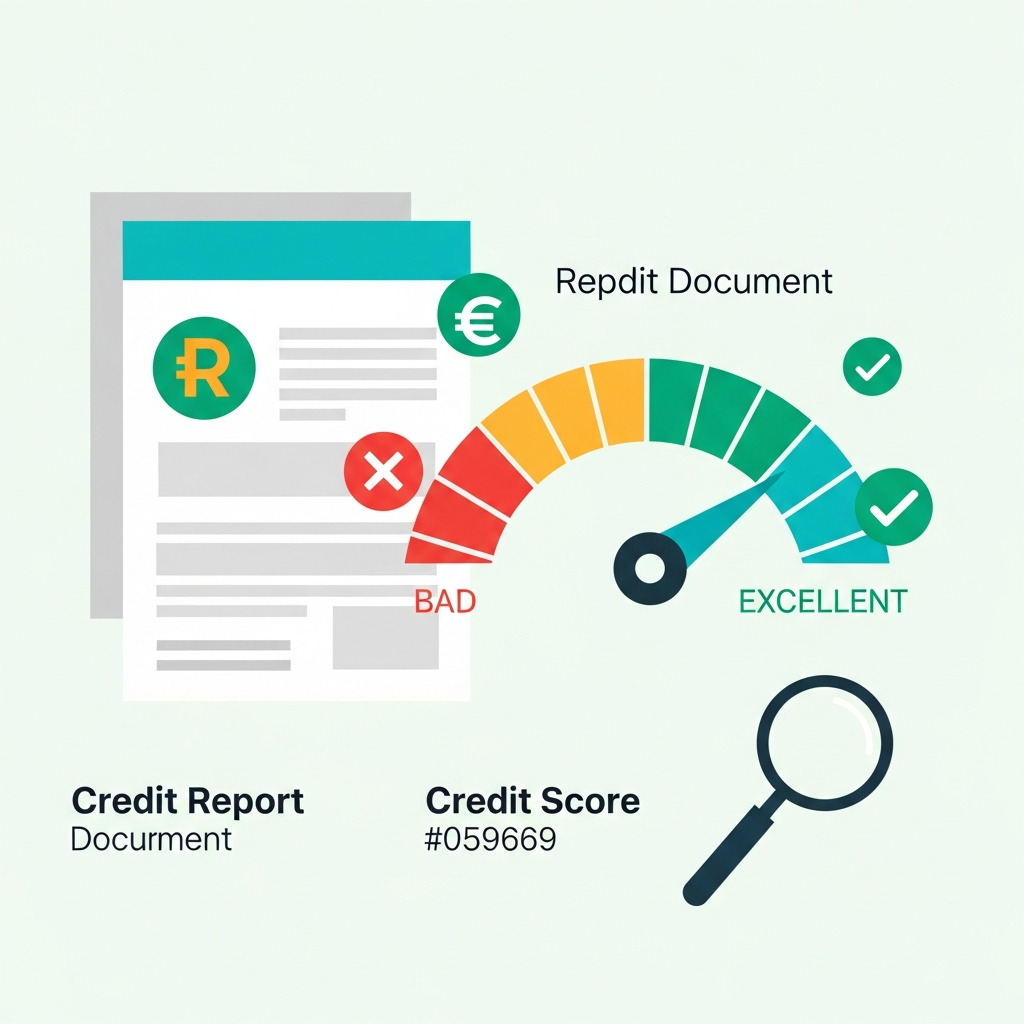
Your credit score is a three-digit number — usually between 0 and 999 if you're checking TransUnion, or up to 657 at Experian. Each of the four major credit bureaus (TransUnion, Experian, Compuscan, XDS) calculates their own version using slightly different models. So your TransUnion score might be 720, while Experian has you at 580. This variation drives people mad, but it's normal.
The number itself is generated from your credit report — that record of your borrowing history. How many accounts. How much you owe. Whether you pay on time. Any defaults or judgments. How long you've been using credit. The bureaus run this data through a statistical model that predicts: what's the chance you'll default on new credit in the next 12 to 24 months? Higher score = lower predicted default risk. Got it.
But here's what most people miss: the score is a summary, not the decision. When you apply for a loan, the lender doesn't simply glance at your number and approve or reject you. They pull your full credit report, run their own internal scoring model (which weights factors differently based on their risk appetite), and run an affordability assessment. Two lenders can look at the same report and reach completely different decisions.
Capitec might approve you at 18%. Standard Bank might decline. FNB might offer 22%. Same report. Different outcomes.
What the Score Actually Controls (And Doesn't)
What It Does Influence
Your approval odds. A higher score generally increases your chances of being approved. But it's not a guarantee. Someone with a 750 score can still get rejected if they fail the affordability assessment. Someone with a 620 score can still get approved if their income-to-debt ratio is healthy. The score is one input, not the entire decision.
Your interest rate tier. Many lenders use risk-based pricing. Your rate is partly determined by your credit risk profile. A better score might get you 16% instead of 24% on a personal loan. On R100,000 over 60 months, that difference saves approximately R22,000 in total interest. Significant. But only if you're being approved in the first place.
Your credit card or overdraft limit. Revolving credit products often set higher limits for better credit profiles. Less relevant if you're trying to get a loan.
What It Does NOT Control
Affordability assessment. Under the National Credit Act, every lender must verify you can actually afford the repayments. No score, however perfect, overrides the fact that your expenses exceed your income. If the math doesn't work, the application gets declined. Score irrelevant.
Employment and income verification. Lenders verify your income independently. A perfect score with a three-month employment history or R8,000 monthly income won't get you approved for an R150,000 loan. They need proof your job is stable.
Your existing debt burden. You might have a decent score (because you've paid on time), but if you already owe R200,000 across multiple accounts, your debt-to-income ratio tells the lender you're stretched thin. The score reflects behaviour. The affordability assessment reflects capacity.
A lender's specific risk appetite. A micro-lender approving R2,500 payday loans has a completely different scoring threshold than a bank approving R300,000 personal loans. Your score isn't evaluated against a universal standard.
The Real Hierarchy: What Actually Matters Most
If your goal is to get approved for credit at the best possible rate, here's what matters — ranked by impact.
1. Income and Employment Stability
Nothing matters more. A stable R25,000 monthly salary with permanent employment opens doors no credit score unlocks. Lenders want to see verifiable income from the same employer for 3 to 6 months, paid into a bank account they can audit. Self-employed? They want 6 to 12 months of bank statements showing consistent business income.
Income is the foundation. Everything else is negotiable. No stable income, no loan.
Time to improve: This is a long game. Career development, salary negotiation, job stability. The single largest impact on borrowing capacity.
2. Your Debt-to-Income Ratio
This is where the real power lies. Your DTI measures how much of your monthly income goes to debt repayments. Lenders use this as the primary affordability metric. Below 35-40% is healthy. Above 50%? Most lenders decline you, even with an excellent score.
Here's the magic: paying off a R1,500 store card doesn't just improve your score over time. It immediately frees up R1,500 of monthly capacity that a lender can see in your affordability assessment. The impact is instant and dramatic. You could jump from declined to approved in one month.
Time to improve: 1 to 6 months by paying off small debts. This is the highest-return action most South Africans can take.
3. A Clean Payment History
Now the score starts to matter. Not the number itself, but the negative listings. A consumer with a 650 score and zero defaults is treated completely differently from a consumer with a 650 score and two defaults.
Have negative listings? Address them. Check whether they're accurate — errors are surprisingly common. Dispute incorrect information directly with credit bureaus (TransUnion, Experian, Compuscan). If the listing is legitimate but paid, request a paid-up letter and submit it to the bureau to update the status.
Time to improve: 1 to 3 months to dispute errors. Legitimate defaults stay for 1 to 2 years after settlement.
4. The Credit Score Number Itself
Yes, it matters. Fourth on this list, not first. Once you have stable income, healthy DTI, and a clean report, the score fine-tunes your rate. The difference between a 680 and a 780 might be 2 to 4 percentage points on your interest rate. On a R50,000 loan over 36 months, that's roughly R2,000 to R4,000 in total interest. Meaningful, but not life-changing.
However — and this is critical — if your income is insufficient or your DTI is already at 50%, moving your score from 680 to 780 won't save you. You'll still be declined.
Time to improve: 6 to 24 months of consistent on-time payments. Diminishing returns once you hit 700+.
5. Your Banking Relationship
Where you bank and how you use your account matters more than most people realise. The Big Five banks give preferential treatment to existing customers. If your salary is paid into an Absa account and you apply for an Absa personal loan, that bank already has months of transaction data showing your income, spending patterns, financial behaviour. This data is often more predictive than your score.
Avoid bounced debit orders. Don't live in overdraft. Show consistent savings behaviour. These signals count.
Time to improve: 3 to 6 months of clean banking behaviour. Entirely within your control.
6. What You're Actually Asking For
An often-overlooked factor: the request itself. Ask for R50,000 when your affordability assessment supports R35,000, you get declined. Ask for 72 months when 36 months would lower risk, you might get a higher rate. Sometimes the most effective way to get approved is simply to ask for less money over a shorter term.
Time to improve: Zero. Apply strategically.
A Real Scenario: Same Score, Wildly Different Outcomes
Consider two borrowers, both with a 680 credit score.
Sipho earns R30,000 monthly, been at the same job for 3 years, R4,500 in existing debt payments (DTI: 15%), clean report — no defaults. He applies for R80,000 over 48 months.
Lerato earns R22,000 monthly, changed jobs 2 months ago, R9,500 in existing debt (DTI: 43%), has a settled default from 18 months ago. Same loan request, 60 months.
Same score. Completely different applications. Sipho gets approved at 16-18%. Lerato gets declined or offered R40,000 at 24-26%. The score was identical. Everything else was different.
Now imagine Lerato spends six months paying off her Woolworths card (R2,200/month freed up) and her small personal loan (R1,800/month freed up). Her DTI drops from 43% to 25%. Same 680 score. Same settled default. But now she's a fundamentally different applicant — far more likely to be approved, at a better rate.
Which Credit Score Improvements Actually Matter
Not all advice is equally valuable. Here's what moves the needle meaningfully.
High Impact (Do These First)
Pay everything on time, every month. Payment history is approximately 35% of your credit score calculation. One missed payment can drop your score 50 to 100 points. Set up debit orders for minimums on every account. Never miss a date.
Reduce your total debt. This improves your score (lower utilisation ratios) AND your affordability (lower monthly commitments) simultaneously. It's the only action that improves both at the same time.
Dispute errors on your credit report. Pull your free annual report from each bureau and check every account listed. Incorrect defaults, accounts you don't recognise, outdated information — dispute immediately. This is free, takes hours, and can result in significant score improvements.
Medium Impact (After the Basics)
Keep utilisation below 30%. If your credit card limit is R10,000, keep the balance below R3,000 at statement date. High utilisation signals financial stress. But paying down debt (high impact) automatically reduces utilisation, so this often takes care of itself.
Don't close old accounts. Your credit history length contributes to the score. Keep an old credit card open (zero balance) if the annual fee isn't significant.
Low Impact (Don't Obsess)
Checking your own score is free. It's a soft enquiry. Zero impact. Check it as often as you like.
Multiple applications do cause a small dip. Each hard enquiry costs roughly 5 to 10 points for 6 to 12 months. Minor compared to payment history or utilisation.
Credit mix helps marginally. Having both revolving credit (credit card) and instalment credit (personal loan) is slightly better. Don't take on unnecessary credit just for this — the risk outweighs the 10 to 20 point benefit.
When Obsessing Over Your Score IS Worth It
You're planning a home loan in 6 to 12 months. Home loans are massive amounts over long terms. Even 0.5% in savings equals roughly R120,000 on a R1.5 million bond over 20 years. Every score point has meaningful financial return.
Your score is 580 to 650. This is the borderline zone. A 30 to 50 point improvement shifts you from likely-declined to likely-approved, or to a better rate tier. The return is outsized.
Your report has errors dragging you down by 50 to 100 points. Disputing them is high-return work. The improvement happens quickly once corrected.
When Improving Your Score Is Wasting Your Time
Your score is already above 750. Going from 750 to 800 might save 0.25% on your rate — meaningful on a home loan, negligible on a R20,000 personal loan. Your time is better spent comparing lender offers. A 3% difference between lenders dwarfs a 0.5% score-driven difference.
Your DTI is above 40%. No amount of score improvement fixes an affordability problem. Focus 100% on reducing debt. The score will improve as a side effect.
You have no stable income. A perfect credit score without stable employment gets you nowhere. Sort out employment first.
You need credit in the next 30 days. Credit score improvement takes months. If you need a loan now, focus on lenders whose criteria match your actual profile, comparing offers, and optimising the amount and term.
The Five-Step Plan That Actually Works
Step 1: Stabilise your income. Get a steady job. Keep it. If you're self-employed, build 6+ months of consistent bank deposits. This is the foundation.
Step 2: Crush your debt-to-income ratio. Use the debt snowball method to eliminate small debts. Every account you close frees up monthly capacity. Highest-impact action for loan approval.
Step 3: Clean up your credit report. Pull your free reports, dispute errors, update settled defaults to paid status. Remove anything that shouldn't be there.
Step 4: Maintain on-time payments. Automate minimums on every account. Your score will climb steadily over 6 to 12 months.
Step 5: Compare lenders, not scores. A 3% interest rate difference between two lenders has a far larger impact on your total cost than a 20-point score improvement. Compare personal loan offers from multiple registered lenders and find the best deal for your actual profile.
The Real Bottom Line
Is improving your credit score worth it? Yes. But it's probably not the most important thing you can do. Reducing existing debt is the single most impactful action for most South Africans. It improves your DTI, your score, and your financial wellbeing simultaneously. A clean credit report matters more than a specific number. Stable income matters more than both. And comparing lender offers matters more than squeezing out another 20 points.
Stop chasing perfect. Start building a complete financial profile — income, affordability, clean history, smart lender selection — and the score will follow.
Compare personal loan rates from registered South African lenders and discover how much your actual profile is worth. The rate difference between lenders is often larger than the difference between credit score tiers.