
Every entrepreneur I've ever spoken to remembers the exact moment they decided to start. A gap in the market nobody was filling. A skill they had that people kept paying for informally. A moment of frustration working for someone else that finally tipped over into action. The idea is never the problem.
The problem is always: where does the money come from?
And sooner or later, someone suggests a loan. Maybe a friend who did it. Maybe an article online. Maybe the bank sending you a pre-approval SMS at exactly the right moment. So let's have the real conversation about it — the genuine pros, the genuine cons, and the questions you should be able to answer before you sign anything.
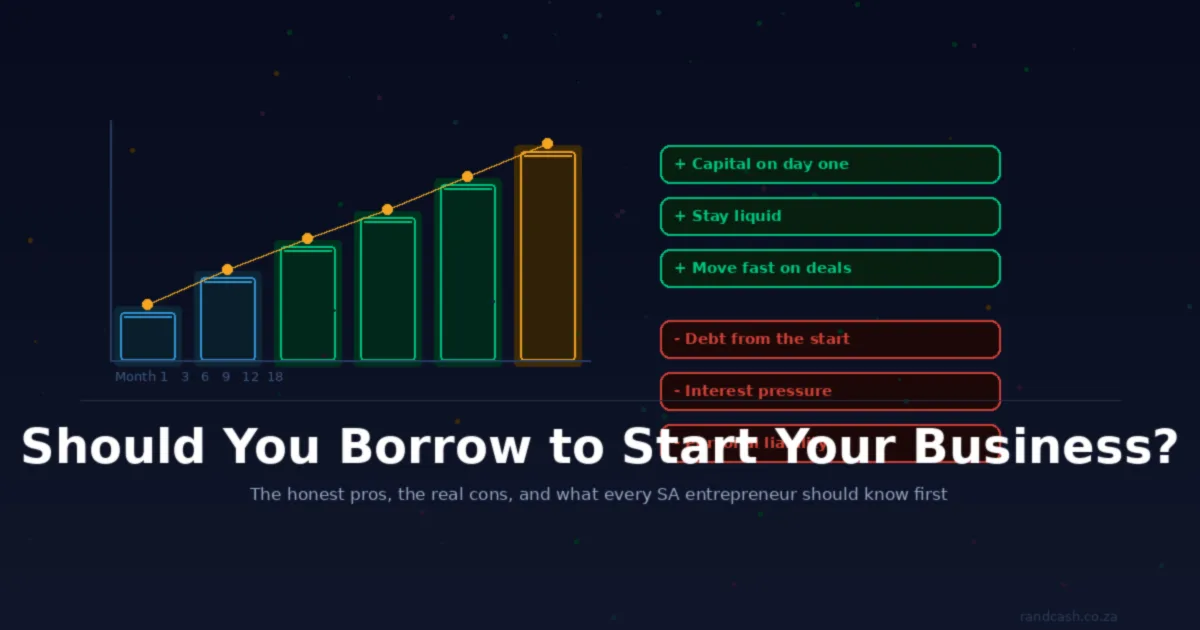
The single biggest advantage of borrowing to start a business is that it lets you begin without depleting the savings you need to live on while the business finds its feet.
People underestimate how long it takes for a new business to generate reliable income. Most small businesses in South Africa — a spaza shop, a cleaning service, a food stall, a small construction operation — take anywhere from three to twelve months before cash flow is genuinely predictable. That's a long time to be eating into personal savings while simultaneously trying to grow something.
If you borrow R30,000 to stock your shelves and pay your first month's rent, and you keep your R30,000 in personal savings untouched as a buffer, you've effectively given yourself twelve months of runway instead of six. That breathing room is real. It changes how you make decisions — you negotiate better, you don't panic-sell at bad margins, you can wait for the right supplier deal instead of grabbing the first available one.
The second genuine advantage is speed. Opportunity in the South African market moves fast. The informal economy — that whole layer of business that doesn't make the newspaper but keeps millions of families going — runs on who acts first. If a supplier has stock available for R15,000 that you know you can move for R25,000, the person with access to R15,000 wins. Full stop. A loan gives you access to capital at the moment the opportunity exists, not three months later when you've saved enough.
And the third is something people rarely mention: building a business credit profile. If you borrow and repay responsibly, you're building a track record that makes future financing easier and cheaper. The business that has serviced a R20,000 loan cleanly is in a very different position when applying for R200,000 two years later than the business with no credit history at all.
Now the cons. And I want to be honest about these because most articles written to sell you financial products gloss over them.
Starting with debt means starting with pressure. From the first day of trading, you have a fixed repayment obligation — regardless of whether the month was good or bad. Revenue is unpredictable for a new business. Repayments are not. That asymmetry creates stress, and stress creates poor decisions. I've watched people undersell their products just to generate cash for month-end. I've watched people take on bad clients they knew were bad because they needed the invoice. Debt pressure does that.
The second problem is specific to South Africa: the interest rates on unsecured business loans — or personal loans used for business purposes — are meaningfully higher than mortgage rates or vehicle finance. You might be paying 18% to 24% on borrowed capital while your business is still figuring out if it can generate a 30% gross margin. Those numbers need to work together or the loan eats the profit.
Third: personal liability. In South Africa, most small business owners can't access formal business credit without a personal surety. Which means if the business fails, the debt doesn't stay with the business. It follows you. Your personal credit record. Your personal assets in some cases. This is not a reason never to borrow, but it's absolutely a reason to borrow carefully — amounts you could theoretically repay even in a worst case.
And fourth — and this one is uncomfortable — many new businesses fail. Not because the owner was lazy or the idea was bad, but because timing was wrong, competition moved, costs shifted, the economy did something unexpected. When a business fails with no debt, you lose your investment of time and savings. When it fails with debt, you lose those things and you're still making repayments on something that no longer exists. That's a different kind of hard.
So where does that leave us? The honest answer is that a loan to start a business is neither automatically a good idea nor automatically a bad one. It depends entirely on what you're borrowing, for what purpose, at what rate, and whether the math works.
There are a few questions I'd want to be able to answer before taking on that debt.
The first is: what is the loan specifically for, and does it directly generate revenue? Borrowing to buy stock you'll resell is different from borrowing to renovate an office that's "nice to have." The first creates a direct return; the second creates an overhead. Borrow for the first category. Bootstrap the second.
The second question: what's my break-even? If I borrow R25,000 and my monthly repayment is R2,200, what level of monthly revenue do I need to cover costs plus that repayment and still eat? If you can't answer that number clearly, work it out before you sign. If the number seems unreachable in the first six months, think hard about the size of the loan.
Third: what happens if the first three months are terrible? Not as a scare tactic — as a planning exercise. Do you have a fallback? A part-time income? Savings that cover the repayment while the business finds its feet? If the answer is no, the risk profile of borrowing is very high regardless of how confident you feel about the business.
And finally: have you looked at alternatives? In South Africa there are options beyond standard personal loans. SEDA offers support for small businesses. The National Empowerment Fund has specific programmes for certain sectors. Some municipalities have funding for SMMEs. These aren't always faster or easier, but the cost of capital is sometimes better. Know your options before you default to the most accessible one.
The businesses I've seen succeed with borrowed startup capital share a few things in common. They borrowed for a specific, revenue-generating purpose. They kept the amount conservative — enough to get started, not enough to fund a dream version of the business before proving the basic model works. They had a clear repayment plan that accounted for slow months. And they treated the loan repayment as the most non-negotiable line item in their budget, above everything except food.
The ones that struggled borrowed too much, too early, for the wrong things — branding before customers, equipment before orders, offices before any reason to have an office.
The loan is a tool. Like any tool, it does damage in the wrong hands and does remarkable work in the right ones.
If you've done the numbers, the purpose is clear, and the repayment fits your realistic cashflow — then borrowing to start your business is a legitimate and often smart move. The South African informal and small business economy is full of people who built something real starting from borrowed capital.
Just go in with your eyes open. That's all.
If you're exploring your options, take a look at registered lenders in South Africa and read up on responsible borrowing before you commit to anything. The right loan at the right moment can genuinely change the trajectory of a business. The wrong one at the wrong moment can make a hard road much harder.
Good luck out there.
— Romans