
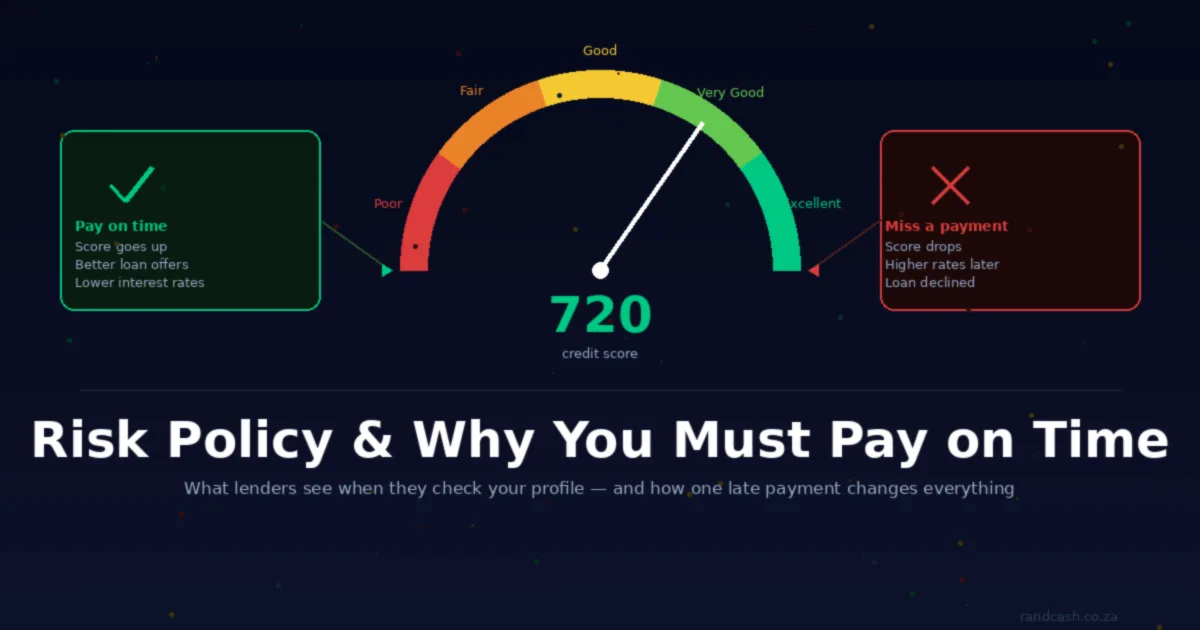
There's a file somewhere in South Africa with your financial life in it.
You didn't sign up for it. You didn't choose to be in it. But the moment you opened a bank account, took out a cell phone contract, or borrowed R500 from a registered lender, you were in. The credit bureaus — TransUnion, Experian, XDS — have been quietly watching ever since. Every payment. Every skip. Every time you paid three weeks late because payday was still far.
It all went in the file.
This is what people mean when they talk about risk policy. And once you understand what it actually is — how it works, who sees it, and what it costs you when things go sideways — you start to treat your monthly payments very differently.
When a lender receives your loan application, they need to answer one question before anything else: what is the probability that this person doesn't pay us back?
That's risk. And every registered lender in South Africa operates under a risk policy — a set of internal rules that decides who gets approved, at what rate, and for how much. It's not personal. It's not the loan officer having a bad day. It's a system, and your credit score and payment history are the main inputs that system runs on.
Think of it like this. Imagine you're lending your car to someone. You'd think about whether they've crashed before. Whether they returned the last car on time. Whether they've got a history of small accidents nobody knows about. You're doing a risk assessment without calling it that. Lenders do exactly the same thing, just with data and algorithms instead of gut feel.
High risk applicant: higher interest rate, lower approval amount, sometimes declined entirely.
Low risk applicant: better rate, more money available, faster approval.
Your history determines which category you land in. And your history is built one payment at a time.
Here's the part most people don't fully appreciate until it's already too late.
A single missed payment doesn't just cost you the late penalty. It goes on your credit profile, and it stays there. In South Africa, adverse information — missed payments, defaults, judgments — can stay on your credit record for up to five years. Five years. That's two World Cups. Three general elections. An entire cycle of a child going from Grade 4 to matric.
And during those five years, every time you apply for anything credit-related — a home loan, a vehicle finance deal, a personal loan, even some rental applications — the person reviewing your profile sees it. They see that you had a period where you didn't pay. And their risk model flags you accordingly.
The really painful part is that the missed payment that caused the problem might have been R300 on a store account you forgot you had. R300. And it's sitting there quietly tanking your chances at a R500,000 bond five years later.
The National Credit Act created the framework that governs all of this in South Africa. It's actually quite protective of consumers — it limits what lenders can charge, requires proper affordability assessments, and gives you the right to access your own credit report for free once a year through any of the registered credit bureaus.
That last part is underused. A huge number of South Africans have never checked their own credit report. Some of them are being declined for loans because of an error on the record — a debt that was paid but never marked as settled, a judgment from five years ago that should have been removed but wasn't. You can dispute these. You can get them corrected. But only if you know they're there.
If you haven't checked your credit report recently, go do it. It takes twenty minutes and it's free. What you find might explain a lot of things that have been confusing you.
Now let's talk about what good behaviour actually looks like, because it's simpler than people make it.
Pay on time. Every time. Even if it's just the minimum. Even if the amount feels small.
Sounds obvious. But here's why it matters beyond the obvious: the credit bureaus score consistency. A person who pays R500 every single month for 24 months is a better risk profile than someone who occasionally pays R2,000 in a lump sum but goes three months without paying in between. The system is looking for reliability, not volume.
Each on-time payment is a small positive data point. Each missed payment is a negative one. Over time, these accumulate into your credit score — a number that lenders use as a quick read on how reliable you are. The higher the score, the better your options. Better rates. Higher approved amounts. More lenders willing to compete for your business.
That competition matters. When your credit score is strong, lenders want you as a customer and they'll price accordingly. When it's weak, you're considered a risk and they price that in — which means you pay more interest, which makes the loan more expensive, which makes your financial situation harder. It compounds against you.
There's a concept called the debt-to-income ratio that lenders also watch closely. It's exactly what it sounds like — how much of your monthly income is already going toward debt repayments. If you earn R15,000 a month and you're already paying R8,000 in debt repayments across various accounts, your debt-to-income ratio is over 50%. Most lenders will decline you, not because you're a bad person, but because their risk policy says someone in that position has very little room to absorb another repayment before something breaks.
This is why getting into a debt spiral is so hard to escape. Each new loan you take to cover the previous one increases your ratio. Each increase makes you riskier. Each risk upgrade means a higher rate. Higher rates mean bigger repayments. Bigger repayments mean more strain. More strain means missing payments. Missed payments damage the credit score. And now you're in a place where even the expensive lenders are starting to say no.
The way out of that spiral is the same as the way to avoid it in the first place: borrow only what you can genuinely repay, pay on time without exception, and know what's on your credit profile.
If you're in a situation where you know a payment is coming that you won't be able to meet, the single most important thing you can do is contact the lender before you miss it. Not after. Before.
Most NCR-registered lenders would rather arrange a payment plan than have a delinquent account on their books. A payment arrangement doesn't look great on your credit profile, but it looks considerably better than a straight default. It shows you're engaging with the problem instead of running from it. That distinction matters — both to the lender and to the credit bureau record.
Running from it, ignoring the calls, hoping it goes away — that's the route to a default, then a judgment, then a potential garnishee order. Each of those steps is worse than the one before it and harder to recover from. A conversation you dread having is worth infinitely more than the silence that leads to a judgment.
Risk policy isn't about lenders trying to catch you out. It's a system built on information — and you have more control over that information than most people realise. Pay consistently, check your own record annually, address problems early when they come up.
Your credit profile is your financial reputation. It takes years to build and can take months to damage. Treat it like what it is — one of the most valuable financial assets you have, even though it doesn't show up in your bank account.
The people who understand this sleep better at night. And they get approved at better rates. Both things are worth having.