
On this page (7)
- 1.What is actually legal to deduct from a grant
- 2.Current grant amounts, so you can check your own account
- 3.Can you get a loan on a SASSA grant?
- 4.Why the card deadline is your opening
- 5.How the swap works, and how the scams work
- 6.If money is coming off your grant that you did not agree to
- 7.If you actually need money before month-end
There are two weeks left on a deadline that affects about 2.9 million people, and it happens to be the best opportunity in years for anyone whose grant has money disappearing out of it every month.
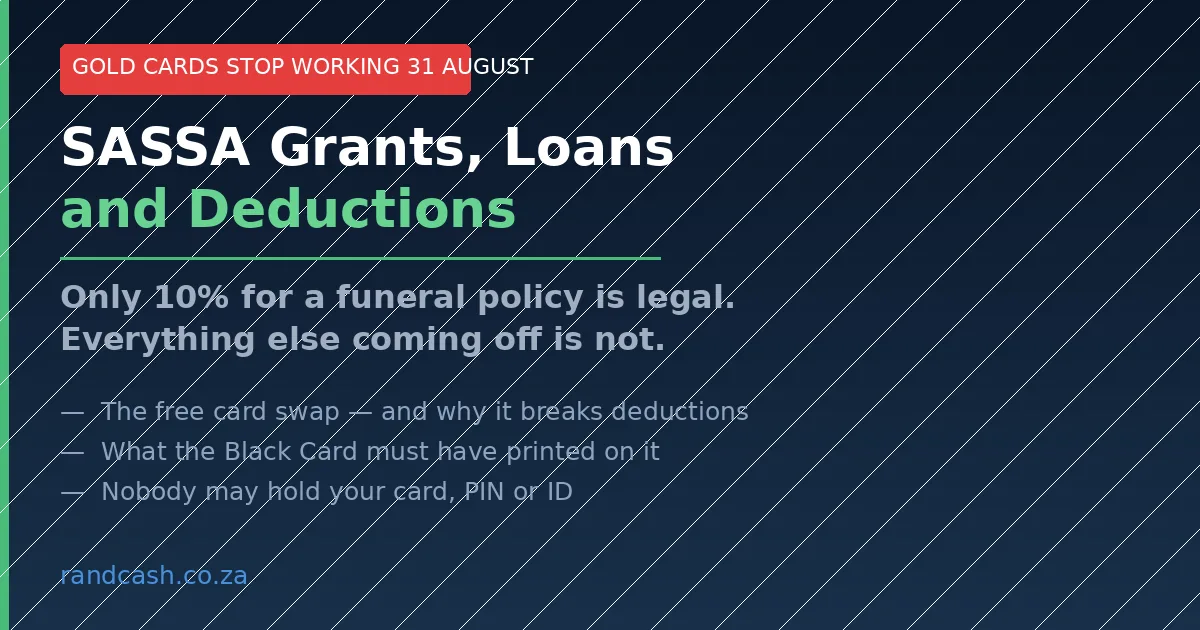
SASSA Gold Cards stop working after 31 August 2026. Everyone still using one has to collect a Postbank Black Card. It is free, it takes one visit, and it works immediately.
That is a logistics story on its face. The reason it belongs on a site about credit is that a card swap does something a complaint letter cannot: it kills the payment instrument that unlawful deductions and card-holding lenders depend on. If something has been coming off your grant that you never properly agreed to, this is the moment it becomes easy to stop.
What is actually legal to deduct from a grant
This is the part most beneficiaries have never been told, and it is much narrower than the practice suggests.
Under Regulation 29 of the Social Assistance Act, the only deduction SASSA may allow directly from a social grant is one funeral policy, capped at 10% of the grant value, and only where the beneficiary has consented to it. One. Ten percent. With consent.
That means, on the current amounts, a maximum of R240 a month on a R2,400 older persons or disability grant, and R58 on a R580 child support grant.
Everything beyond that single funeral deduction is outside what SASSA may permit. Black Sash and GroundUp have documented for years what actually shows up on beneficiary accounts instead: loan repayment deductions nobody authorised, multiple funeral schemes stacked on one grant, prescribed debt being collected years after it lapsed, advance electricity, airtime, and in some cases water. SASSA itself has stated it has no authority to make deductions without the beneficiary’s consent.
So if you are on a grant and more than one deduction is coming off, or any deduction other than a single funeral policy within 10%, the starting assumption should be that it is unlawful — not that it must be legitimate because it has been happening for a long time.
Current grant amounts, so you can check your own account
These took effect in April 2026 and hold until the next increase in October.
Older Persons Grant, ages 60 to 74: R2,400. Older Persons Grant, 75 and over: R2,420. Disability Grant: R2,400. Care Dependency Grant: R2,400. War Veterans Grant: R2,420. Child Support Grant: R580. Foster Care Grant: R1,290. Grant-in-Aid: R580. SRD: R370, which did not increase this year.
Take the figure for your grant, compare it against what actually arrives in your account, and the gap is your deductions. People are often surprised by the size of that gap, because the deductions accumulated one at a time over several years.
Can you get a loan on a SASSA grant?
Let me answer this directly, because it is one of the most searched credit questions in South Africa and most of what comes back is written by people trying to sell something.
A grant cannot be used as security for a loan, and unauthorised deductions against a grant account to collect a loan are unlawful. That is the legal position.
The practical position is that some lenders lend to grant recipients anyway, and the model is exactly the problem Black Sash has been documenting. A borrower with no assets and no formal salary has one thing a lender can reach — a predictable monthly government payment landing in a known account on a known date. The lending is not underwritten on affordability in any meaningful sense. It is underwritten on access to that payment.
Then look at the arithmetic on an SRD grant. R370 a month. Under the NCA a registered lender must satisfy itself that you can repay while still covering your basic living expenses. There is no honest affordability assessment that concludes a person receiving R370 a month can service a loan. Any lender advancing credit against an SRD grant is either not conducting the assessment or not registered, and in both cases you are not dealing with someone who will treat you fairly when something goes wrong.
On the larger grants — R2,400 for older persons and disability — the position is less absolute, but the structural problem is the same. A grant is subsistence income. It is calculated to cover basic living costs and nothing more. There is no room in it for debt servicing, which is why deductions against grants produce the outcomes they do: beneficiaries running out of money in the third week, borrowing again to bridge, and the deductions compounding.
So the honest answer is that borrowing against a grant is rarely going to end well, and the reason has nothing to do with the borrower’s character. It is that the income was never sized to carry debt.
Why the card deadline is your opening
Now the useful part.
If a lender is physically holding your SASSA card — and this is common, particularly with informal lenders who take the card and PIN so they can withdraw on payment date — that card stops working on 31 August regardless of what anyone agreed. Whatever hold they had over your money ends with it.
You collect a free Black Card, with a new PIN, in your own name, and the person holding your old card has a piece of dead plastic.
Holding a beneficiary’s SASSA card as security is unlawful in any event, and always was. But the enforcement problem for beneficiaries has always been practical rather than legal: confronting a lender to get your card back is intimidating, and reporting it feels like it invites trouble. The card expiry removes the confrontation entirely. You do not have to ask anyone for anything. You go and collect a new card, and the old arrangement simply stops functioning.
The same logic applies to unauthorised debit orders on your grant account. A card swap is the natural moment to go through what has been coming off, identify what you never agreed to, and stop it — and Postbank has said the Black Cards carry stronger protection against unauthorised deductions.
How the swap works, and how the scams work
The legitimate process is deliberately simple, which is worth knowing precisely, because every detail that gets added to it is a sign of fraud.
You take a valid or temporary ID to a Postbank service point. You collect the Black Card. It costs nothing. It works immediately. You do not need to visit a SASSA office afterwards, and you do not need to complete or sign any forms.
That last point is the single most useful thing in this article. No forms are required. So if anyone puts a document in front of you as part of a card replacement, something is wrong.
The scams currently running:
Impostors at your home. People presenting themselves as Postbank or SASSA officials, doing house visits, telling beneficiaries their card needs fixing or that payments will be blocked unless they hand it over. They collect the card and the PIN. Postbank does not do this. There is no home card-collection service.
Anyone asking for a fee. The replacement is free. A fee request identifies a scammer with certainty, whatever the amount and whatever the explanation.
Anyone asking for your PIN or an OTP. Postbank will never ask for either. Not on the phone, not at a table in a shopping centre, not at your door.
Fake cards. A genuine Black Card has “Postbank” printed on the front. If it does not say Postbank on the front, it is not a real card.
And the general rule that covers all of it: nobody — not a lender, not an official, not someone helping you with paperwork, not a family member managing your affairs — has any legitimate reason to keep your SASSA card, your PIN, or your ID document. Retaining a beneficiary’s card or ID is a criminal matter, not a grey area.
If money is coming off your grant that you did not agree to
Do these in order. All of them are free.
Collect your Black Card first, before 31 August, while the deadline is doing the work for you. New card, new PIN.
Then get a statement and list every deduction. Compare it against the grant amount above. Identify anything that is not a single funeral policy within 10%.
Then report it. SASSA has a process for unlawful deductions and has publicly committed to stopping them — raise it at your nearest SASSA office and ask for a reference. Black Sash exists precisely for this and has more experience with grant deductions than anyone else in the country; their Community Advice Offices help beneficiaries directly at no cost. Legal Aid South Africa on 0800 110 110 is free if you fall within their means test, which grant recipients do by definition.
If a lender is holding your card or ID, report it at your nearest SAPS station and get a case number. You do not need the original documents back — the card is expiring and the ID can be replaced.
Refunds have happened before, in volume, where deductions were found to be unlawful. It is not a theoretical remedy.
If you actually need money before month-end
Because saying “do not borrow” to someone who needs R400 for electricity is not advice, it is a lecture.
Ask about SASSA’s Social Relief of Distress assistance, which is designed for exactly this — a temporary crisis, not a loan, nothing to repay.
If you belong to a burial society or stokvel, that is almost always the cheapest available help and it does not touch your grant.
Speak to whoever the money is owed to before borrowing to pay them. Utilities, schools, and clinics have far more flexibility on payment arrangements than most people expect, and asking costs nothing.
And whatever else happens: do not hand over the card or the PIN. That is the one decision that turns a difficult month into two years of difficult months, because after it you never see your grant before someone else has taken their share of it.
— Romans
General information, not legal or financial advice. For your own situation, Black Sash, Legal Aid South Africa on 0800 110 110, and your nearest SASSA office are the right places to go, and none of them charge.