
The calls usually start on a Tuesday. Then they come at 7am, and at 8pm, and to your work number. Then someone phones your sister. Then a message arrives saying a warrant has been issued and someone will be arresting you.
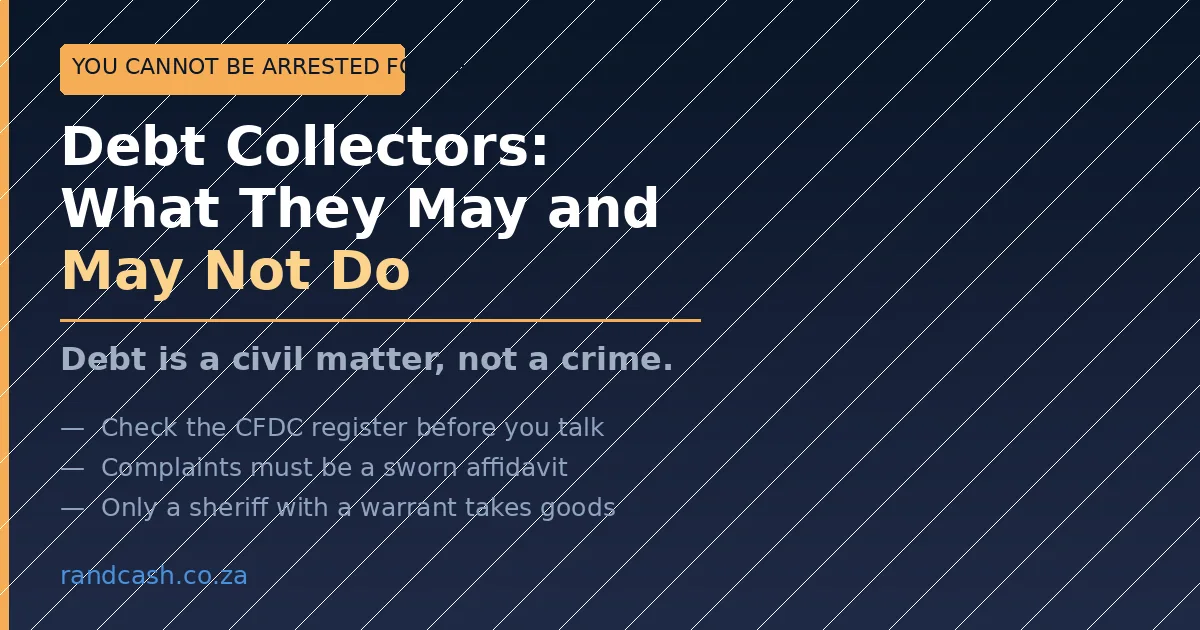
That last one is a lie, and it is worth knowing why before anything else. Debt in South Africa is a civil matter, not a criminal one. You cannot be arrested for owing money. There is no such thing as being locked up for an unpaid store account. A collector who threatens you with arrest or imprisonment is not warning you about a legal process — they are committing an offence under the code they are bound by.
Debt collection is a regulated occupation here, more tightly than most people realise. This sets out what a collector may actually do, what they may not, and the specific procedure that has teeth when they cross the line.
Start by checking whether they are even allowed to do this
Debt collectors are regulated under the Debt Collectors Act 114 of 1998 and must be registered with the Council for Debt Collectors (CFDC). The Council keeps a public register, enforces a Code of Conduct, sets the fees collectors may charge, investigates complaints, and can suspend a collector or strike them off permanently.
So the first move, before you discuss anything, is to ask for the collector’s name, the company name, and their registration number — then check it against the register at cfdc.org.za.
This matters more than it sounds. An unregistered person collecting debt for reward is acting unlawfully, and if the register comes back empty you are not in a negotiation, you are dealing with someone operating outside the system. It also changes the tone of the conversation immediately, because a registered collector knows the register is public and that their registration is the thing they have to lose.
What they are entitled to do
Being fair about this matters, because treating every collector as a criminal will make you ignore letters you should not ignore.
They may contact you about a genuine debt. They may phone you, write to you, and yes, contact you at work — though you are entitled to tell them not to, and to set boundaries on times and channels. They may recover the debt plus interest and the fees allowed under the prescribed tariff. They may instruct attorneys and, if the creditor obtains judgment, pursue enforcement through the court.
And ignoring them has real consequences. Unanswered letters become a Section 129 notice, then summons, then a default judgment you never opposed because you never appeared — and that judgment sits on your record for five years and opens the door to an attachment against your salary. What actually happens if you stop paying walks through that sequence.
Engaging early, even to say “I cannot pay this amount, here is what I can do,” is almost always better than silence.
What they may not do
Threaten you with arrest or criminal prosecution. Covered above. It is the most common unlawful tactic because it is the most effective one.
Lie or misrepresent anything. The Act specifically prohibits a collector from deliberately misrepresenting any fact, truth, instruction or mandate in order to benefit themselves or their principal at your expense. That covers claiming to be an attorney or a sheriff when they are not, claiming a court has ruled when it has not, and inventing legal steps that do not exist.
Tell other people about your debt. Phoning your employer, your neighbours, your family or your church to apply social pressure is not a collection technique, it is a disclosure of your personal information. Under POPIA your data must be handled lawfully and not shared without a proper basis. Collectors do this because shame works — and it is one of the easier breaches to prove, because the third party can give you a statement.
Harass you with calls at unreasonable hours. Repeated calls late at night or very early, or abusive and obscene language, fall foul of the Code of Conduct.
Inflate the balance. They may not add charges beyond the prescribed tariff, and under the in duplum rule the interest accumulated on an unpaid debt cannot exceed the outstanding capital. If you have been paying for years and the balance never moves, that is the rule to invoke.
Collect on prescribed debt. Most unsecured debt prescribes after three years without acknowledgment, payment or a served summons, and since 2015 Section 126B of the NCA makes it unlawful to sell, collect or reactivate prescribed debt. Old debt books get traded repeatedly, so collectors phoning about a 2019 account are common.
The trap here is critical: any payment, any promise to pay, or any written acknowledgment restarts the three-year clock. A R50 goodwill payment revives the entire debt. If you think a debt has prescribed, do not pay and do not acknowledge it — say in writing that it has prescribed and that you invoke Section 126B.
Take your property. No collector may remove anything from your home. Only a sheriff of the court, acting on a warrant of execution after judgment, may attach goods. Anyone else loading your television into a van is committing theft, whatever paperwork they wave. See also repossession.
Deduct from your salary without a court order. That requires an emoluments attachment order granted by a magistrate in the court with jurisdiction where you live or work — and a great many older orders do not survive scrutiny.
Ask them to prove the debt
Before agreeing to anything, request in writing: who the original creditor was, the original capital amount, the date of the last payment or acknowledgment, a full statement of every payment received and every charge added, and proof of their mandate to collect on behalf of the creditor.
Do this by email so there is a record. A legitimate collector acting on a real mandate can produce it. Two things regularly fall out of that request. Debts that have been sold three times over and where nobody can actually document the chain. And balances where the arithmetic reveals charges beyond the tariff or interest past the in duplum ceiling.
Keep a log alongside it — date, time, number, who called, what was said. It takes seconds per entry and it becomes the evidence for everything below.
The complaint that actually works
This is the part most articles skip, and it is the reason casual complaints go nowhere.
A complaint of improper conduct to the Council for Debt Collectors must be made by written affidavit. It must state the date, the time and the particulars of the incident, the name of the debt collector, and the names of any witnesses — and it should be submitted as soon as practical after the incident, with any supporting documents attached.
So a phone call to complain achieves very little, and an email saying “they keep harassing me” achieves not much more. A sworn affidavit saying that on 14 August at 19:52 a named collector from a named company told you a warrant had been issued for your arrest, with your call log attached, is a document the Council must consider — and the sanctions available to it run to suspension and removal from the register.
Commissioning an affidavit is free at any police station or Home Affairs office. That is the whole cost.
Other free routes, depending on the problem. The National Financial Ombud Scheme on 0860 800 900 (nfosa.co.za) handles disputes with credit providers. The National Credit Regulator on 0860 627 627 deals with credit provider conduct and unregistered lenders. Legal Aid South Africa on 0800 110 110 is free within their means test. And if there have been threats of violence, that is a SAPS matter with a case number, entirely separate from the debt.
What to do about the underlying debt
Knowing your rights stops the harassment. It does not make a real debt disappear, and the two problems need separating.
If the debt is valid and you can pay something, negotiate directly. Old accounts are frequently settled for 60 to 80 cents on the rand, particularly ones that have been dormant for years. Get any settlement offer in writing before you pay a cent, and ask for a paid-up letter afterwards.
If several collectors are involved because there are several debts, the problem is structural rather than about any one account — restructuring what you owe is the more useful frame, and debt counselling brings legal protection from creditors while payments are restructured.
And it is worth asking how the loan came to be granted at all. If a lender advanced credit that its own assessment showed you could not carry, that agreement may have been recklessly granted, and a court can set it aside entirely. That is a defence worth raising if a creditor sues you rather than something to leave until afterwards.
One last thing. Collectors work on the assumption that you do not know any of this, because most people do not. The moment you ask for a registration number and put a request for proof of the debt in writing, the interaction changes character — not because you have become difficult, but because you have moved it onto a record, and a record is the one thing an unlawful collection practice cannot survive.
— Romans
General information about South African law, not legal advice on your matter. On whether a specific debt has prescribed, or before signing any settlement, Legal Aid South Africa and the university law clinics assess these at no cost.