
The appeal of buy now, pay later is that it does not feel like credit. You split a R2,400 pair of shoes into four payments of R600, nobody runs a credit check, nothing appears on your credit report, and the word “loan” never comes up.
Two of those things are about to stop being true.
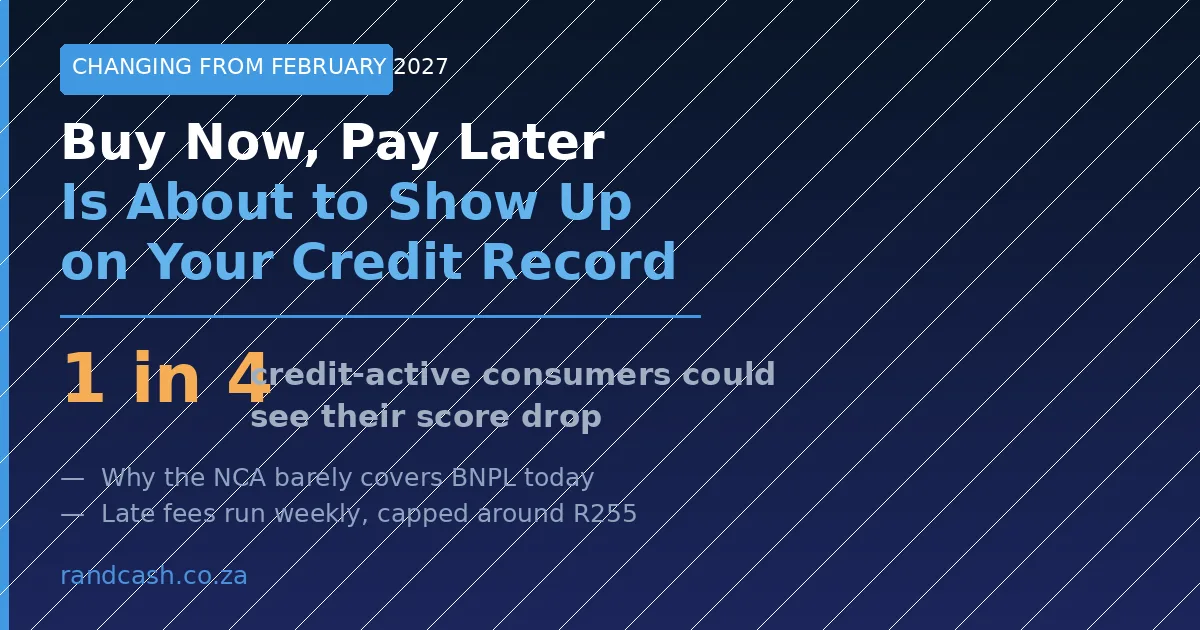
The National Credit Regulator has instructed BNPL providers to start reporting consumer payment behaviour to the credit bureaus from February 2027. PayJustNow has been submitting data to SACRRA voluntarily since April 2026, ahead of the requirement. And TransUnion’s preliminary modelling suggests that once BNPL data enters current scoring models, it could reduce scores meaningfully per product — potentially affecting around a quarter of all credit-active South Africans.
So if you use these products, there is a window between now and February to get your position in order. This explains what BNPL actually is legally, why that matters more than people assume, and what to do before the reporting starts.
How big this has become
The South African BNPL market is expected to reach roughly US$1.17 billion in 2026, growing about 22% year on year. It ran at a 26.6% compound growth rate between 2022 and 2025 and is forecast to keep growing at around 18% a year to about $2.66 billion by 2031.
The names most people will recognise: PayJustNow, Payflex, Float, MoreTyme, Happy Pay, Mobicred. Stitch entered the market in May 2026. The typical structure is that the provider pays the retailer in full within a day or two and then collects the instalments from you, carrying the default risk itself.
That structure is why there is usually no interest. The provider earns from the merchant, not from you — as long as you pay on time.
The legal position, which is stranger than you would expect
This is the part that actually explains everything else.
The NCR has concluded that a BNPL agreement is not a credit agreement at inception. No interest is charged, so it falls outside the definition, and the National Credit Act does not attach at the moment you sign up. Most providers structure deliberately for this outcome, presenting the product as a payment solution or deferred billing rather than as lending.
The consequence is a set of protections that simply are not there. No affordability assessment is required before you are given the facility. No NCR registration obligation as a credit provider. None of the disclosure requirements the NCA imposes on a lender. And, until now, no reporting to credit bureaus — which is precisely why BNPL has been invisible.
Where it changes is on default. Once default charges or fees are levied, the arrangement may become an incidental credit agreement under the NCA, which pulls parts of the Act into play. In other words the consumer protections largely arrive at the point where you have already missed a payment, rather than at the point where someone should have checked whether you could afford it.
The Micro Finance South Africa association has described BNPL as operating in a regulatory void that puts millions at risk. The Reserve Bank has issued its own warning, which BNPL firms publicly pushed back on. The National Financial Ombud published a festive-season piece with the title “All That Glitter Is Not Gold”. This is a live argument, not a settled one.
The stacking problem
Here is the actual mechanism by which BNPL hurts people, and it is not the individual purchase.
Because no affordability check happens and nothing reports to a bureau, no provider can see what the others have given you. Four different BNPL facilities across four different retailers, each entirely reasonable on its own, and no single party — including you, unless you are tracking it — has a view of the total.
Four purchases of R2,400 each, split four ways, is R2,400 a month in instalments. Nobody assessed whether you could carry R2,400 a month, because from each provider’s perspective they only gave you R600.
Then one instalment misses. Penalty fees on these products are charged weekly, with some platforms capping late fees at around R255 per transaction — which on a R2,400 purchase is more than 10% of the item price in fees alone. From there it runs the familiar course: arrears, adverse listing, and eventually formal collection.
And it interacts badly with everything else. BNPL instalments come off your account as debit orders like any other obligation, so they show up when a bank assesses you — lenders read your bank statements line by line, and an account that runs to zero every month because of stacked instalments reads exactly the way it reads for any other over-committed applicant.
What changes in February 2027
Once providers report payment behaviour to the bureaus, three things follow.
Your BNPL use becomes visible to every other lender. A bank assessing your home loan or personal loan application will see the facilities and how you have handled them. This cuts both ways: consistent on-time payment becomes something you get credit for, and missed instalments become something you are marked down for.
Scores are likely to move, and mostly downward at first. TransUnion’s warning is about mechanics rather than behaviour: current scoring models were not designed with BNPL in mind, and feeding in multiple short-duration facilities can look, to a model built around conventional credit, like heavy credit-seeking. The estimate that around a quarter of credit-active consumers could be affected is a statement about how models read the data, not a judgment about the people.
Stacking becomes visible. Providers will be able to see what other providers have extended, which will tighten approvals — the point of the reform, and the reason press coverage has framed it as BNPL users facing tougher credit checks.
What to do before then
Practical, and most of it takes an afternoon.
Count what you actually have open. Most people using BNPL cannot say from memory how many active facilities they hold or what the combined monthly instalment is. Go through your bank statements for the last three months, list every BNPL debit order, and total them. That number is the thing that matters.
Clear what you can before reporting starts. A facility settled and closed before February is a facility not entering the bureaus as an open commitment. If you have spare cash going anywhere, this is a sensible place for it.
Stop opening new ones for a while, especially if a big application is coming. If you plan to apply for a bond, vehicle finance, or a large personal loan in 2027, the months before that application are the wrong time to be accumulating newly-visible short-term facilities.
Move every BNPL debit order to the day after payday. The single cheapest fix on this page. Weekly penalty fees only bite when a payment misses, and payments miss because the money was not there on the day. Aligning the dates removes most of that risk for free — the same logic covered in paying off debt without the constant pressure.
Check your credit report now, so you have a baseline. Free from ClearScore, TransUnion and Experian. Knowing your score before the change means you can tell what BNPL data actually did to it afterwards rather than guessing. How to read and improve your score.
Is BNPL actually bad?
No, and I do not want to pretend otherwise.
Used on one purchase you were going to make anyway, paid on schedule, it is genuinely free credit. No interest, no initiation fee, no monthly service fee. Compare that against a store account at up to 27.75% a year for the same television — the cost comparison is not close. For a disciplined buyer with a known payday, BNPL is the cheapest way to spread a purchase in the South African market.
The problems are specific rather than general. It is bad when it is used to buy something you could not otherwise afford, because splitting a payment does not change affordability, it just moves it. It is bad when facilities stack across providers who cannot see each other. And it is bad when a missed instalment triggers weekly penalty fees on a product you chose precisely because it was interest-free.
The reform arriving in February is a good thing for exactly that reason — the invisibility was the flaw. It just happens to land on people who used these products under the old assumption that nothing was being recorded.
For where BNPL sits relative to everything else available to you, every way to borrow money in South Africa puts it in context.
— Romans
General information, not financial advice. Market and regulatory details reflect reporting available in August 2026 and the implementation timeline may shift — check with your provider and the NCR for the current position.