
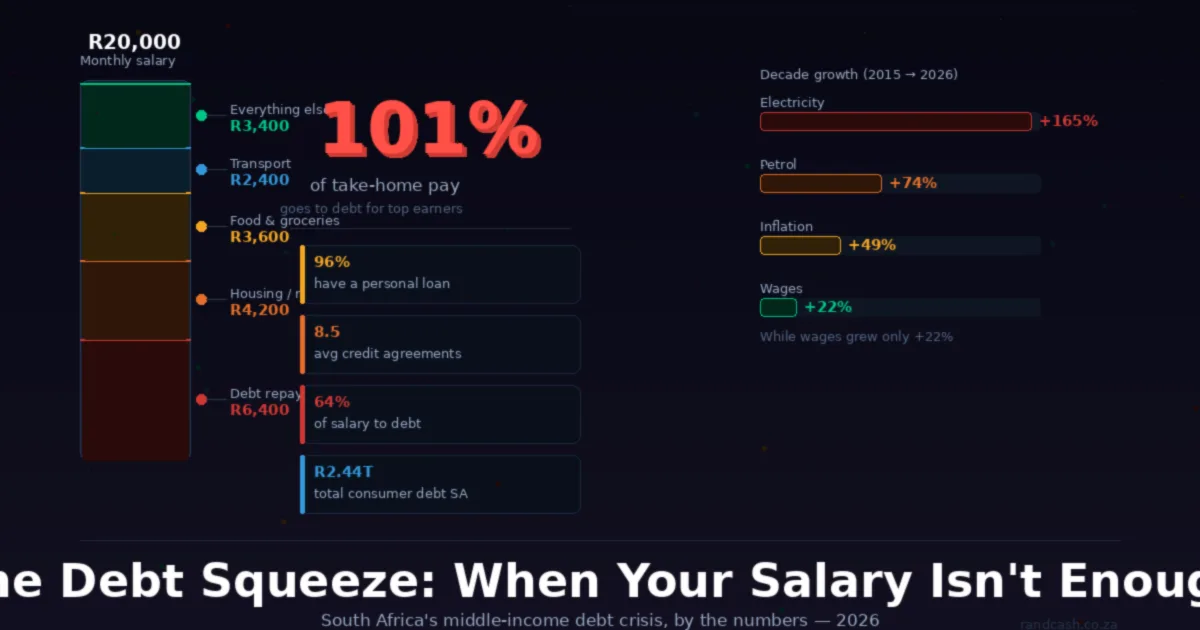
There is a number sitting in the Q1 2026 DebtBusters Debt Index that is hard to read without stopping. South Africans earning more than R50,000 a month — people by almost any measure doing well — are now spending 101% of their take-home pay on debt repayments. Their debt-to-income ratio sits at 303%. They are, technically, insolvent on paper before the month even begins.
This is not a story about people who made reckless choices. It is a story about a decade in which the cost of living moved in one direction and wages moved in another, and the gap between them was quietly filled with credit. Now the credit is due. And the numbers are starting to show it.
The decade comparison is worth sitting with. Between 2015 and 2026, electricity tariffs in South Africa rose by 165%. Petrol prices climbed 74%. Cumulative inflation ran at 49%. And wages, across most income bands, grew by roughly 22%.
Do that maths slowly. For every rand your grocery bill grew, your salary grew less than half a rand to cover it. For every rand your electricity bill added, your salary covered maybe fifteen cents of it. The rest — the gap — had to come from somewhere. For millions of South African households, it came from credit. Personal loans. Store accounts. Credit cards. Payday advances. One agreement at a time, spread across years, until the number of agreements per person applying for debt counselling in Q1 2026 averaged 8.5 — the highest figure recorded since 2017.
Middle-income households — broadly, people earning between R10,000 and R35,000 a month — are where the pressure is most visible right now. Not because they earn least. Because they earn enough to qualify for credit, but not enough to comfortably carry it. They don't qualify for SASSA support. They don't have the financial cushion that higher earners might have. And they're often servicing debt across multiple categories simultaneously: a vehicle instalment, a personal loan, a credit card, store accounts, maybe a bond.
According to the Q1 2026 data, consumers who applied for debt counselling needed an average of 64% of their take-home pay just to service their existing debt. That figure was 71% in Q4 2025. The slight improvement does not tell a recovery story — it tells a story of slightly lower interest rates earlier in 2026 offering some breathing room before the SARB's May rate hike pushed prime back up to 10.50%.
When 64 cents of every rand you earn goes to repayments before you've bought food, petrol, paid rent, or replaced a school shoe — the remaining 36 cents does not stretch. It breaks.
What makes this particularly difficult to talk about is that most of this debt was not taken out irresponsibly. The NCR and DebtBusters data consistently show that the majority of people in financial distress used credit for necessities: school fees, furniture, medical expenses, keeping the lights on during a bad month. The 96% of debt counselling applicants who held a personal loan in Q1 2026 (a record), and the 61% who held a payday or one-month loan (also a record) — most of them were filling gaps, not funding holidays.
That context matters because it changes the nature of the problem. This is not a crisis caused by people spending beyond their means for pleasure. It is a crisis caused by a cost-of-living structure that has systematically exceeded what wages can support, in a country where the safety net is thin and the alternative to borrowing is often going without something essential.
So what does this mean practically, if you're in this situation or heading toward it?
The first thing worth knowing is that the debt counselling process in South Africa — governed by the National Credit Act — exists precisely for this scenario. It is not bankruptcy. It does not erase your debt. What it does is give you legal protection while you repay at a restructured rate and timeline, based on what you can actually afford. A registered debt counsellor negotiates on your behalf, creditors are legally prevented from taking legal action against you while the process is active, and your essential living costs are protected in the repayment calculation. If your debt-to-income ratio is above 50%, it is worth at least having the conversation with an NCR-registered counsellor.
The second thing is about the credit agreements you have not opened yet. The pattern in the data — 8.5 agreements per applicant — usually builds slowly. One personal loan to cover a gap. A store account because the sofa needed replacing. A credit card for emergencies. Each one feels manageable in the month you open it. Collectively, they become the number that shows up in the debt index. Before adding another agreement, calculate the total monthly cost of all current debt repayments as a percentage of your take-home. If it is above 40%, a new agreement is unlikely to help and very likely to accelerate the problem.
The third thing — and this one is less intuitive — is to engage with your existing lenders before you miss a payment, not after. Under the National Credit Act, registered lenders are required to engage with borrowers experiencing genuine financial distress. Payment arrangements, interest rate adjustments, and payment holidays are far more accessible when you make contact proactively. The moment a payment is missed and reported, the options narrow significantly and the cost of the problem rises.
South Africa's total outstanding consumer debt stood at approximately R2.44 trillion as of early 2026. Unsecured credit — personal loans, credit cards, store accounts — makes up a significant portion of that. The SARB's May 2026 rate hike, which pushed the repo rate to 7% and prime to 10.50%, will add further pressure to variable-rate debt across the board. Households that were managing will feel an additional squeeze. Those already stretched will feel it more.
None of this is to say the situation is hopeless. The people who navigate it best are the ones who look at the numbers clearly, act early, and use the tools that exist — debt counselling, lender engagement, structured repayment — before the situation becomes a crisis rather than after. The worst outcomes, consistently, are the ones where people avoided the numbers until avoidance was no longer an option.
The debt squeeze is real. It is structural. And it is affecting people with good salaries and careful habits, not just those at the margins. If you are looking at your own numbers and something does not add up, that is not a personal failing — it is an accurate reading of what has happened to purchasing power in this country over the last decade.
The answer is not more credit to cover the gap. The answer is understanding what the gap actually is, and then working through it systematically, with the tools and protections that exist.
If your debt repayments are taking more than half your income, read our guide on how debt review works in South Africa and your rights as a borrower under the NCA. For a full picture of what different types of credit actually cost, see our comparison of credit types in South Africa.
— Romans