
It is usually a brother. Sometimes a child, sometimes a business partner, occasionally the landlord of a shop your cousin is opening. The ask is small in the telling: just sign here, it is a formality, the bank wants an extra name on the file.
Years later the business fails, or the lease collapses, or the car gets repossessed and sold for less than the settlement — and the letter comes to you. Not to the person who borrowed the money. To you.
Suretyship is the only common financial document where you take on a large liability and receive nothing at all in return. It is also one of the few where the most important words look like legal filler. This is what you are actually signing.
Two protections exist. The standard clause removes both.
South African common law gives a surety two defences, and they are genuinely useful ones.
The first is the benefit of excussion — beneficium excussionis. It says the creditor must first go after the principal debtor and exhaust their assets before turning to you. You are the backstop, not the front door.
The second is the benefit of division — beneficium divisionis. Where several people have signed as sureties, each is liable only for a proportionate share. Four sureties, a quarter each.
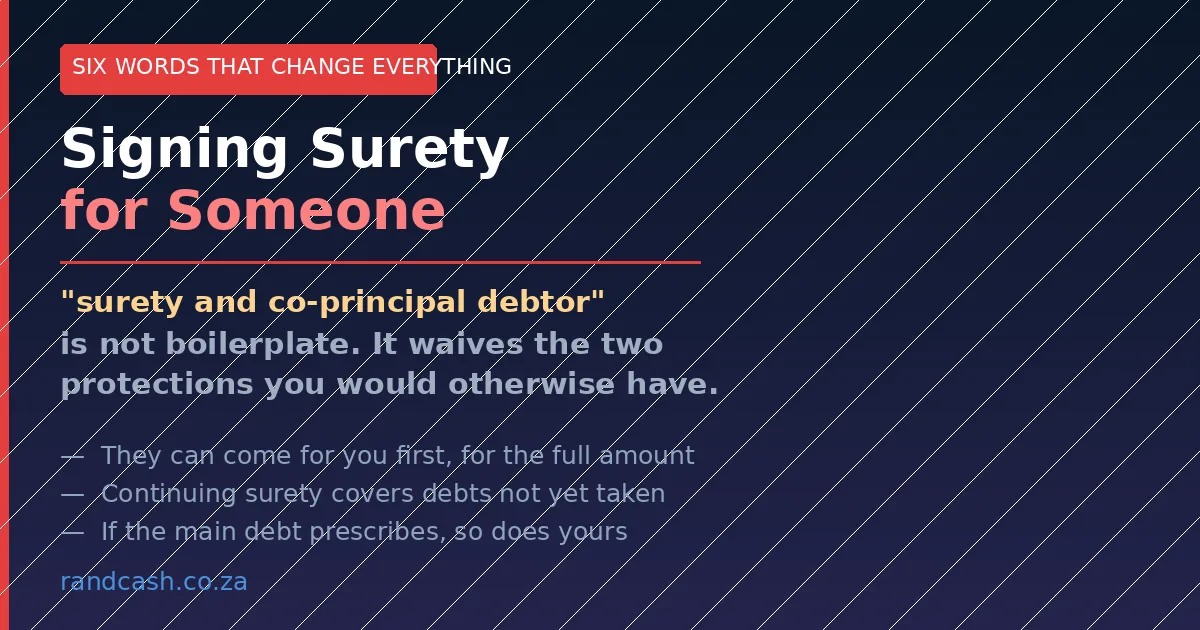
Now look at the phrase that appears in virtually every suretyship deed in this country: “surety and co-principal debtor”.
Binding yourself as co-principal debtor is treated as renouncing both benefits. The courts have been consistent on this, and in Absa Bank v Lowting the position on excussion was put plainly — once renounced, the creditor may proceed directly against the surety without first excussing the debtor.
What that means in practice is the thing people discover too late. The creditor does not have to chase your brother first. They can skip him entirely and sue you, because suing a person with a salary and a house is simpler than suing a failed business. And if there were four sureties, they are not obliged to collect a quarter from each. They can pursue you for the full amount and leave you to go and recover from the other three yourself.
You are not a guarantor in the everyday sense of that word. You are a second borrower who never received the money.
These renunciations are supposed to be express and knowing, which is the whole reason the clause is spelled out rather than implied. If someone tells you it is standard wording and not worth reading, that is precisely the wording worth reading.
The formality that sometimes saves people
One thing is strictly required. Under section 6 of the General Law Amendment Act 50 of 1956, the terms of a suretyship must be in a written document signed by the surety or someone acting on their behalf.
A purely verbal suretyship is void — not merely difficult to enforce, but of no legal force at all. Same where the document exists but the surety never signed it.
So if a creditor is pursuing you on the basis of a conversation, or an arrangement everybody simply understood, or a document you are told you signed, the first step is to demand a copy of the signed deed. It is the foundation of their whole claim and they must be able to produce it.
“Continuing” is the word that does the damage
Most suretyships are drafted as continuing covering bonds. They do not attach to one loan. They attach to the relationship, covering whatever the principal debtor owes the creditor from time to time — including debt not yet incurred on the day you sign.
So you sign for your brother’s R80,000 equipment facility in 2022. In 2025 he increases the facility to R400,000. Unless the deed caps the amount, you are on the hook for the larger number, and nobody has any obligation to tell you it changed.
This is why the two questions to ask before signing anything are: is there a maximum amount, and is there an end date. An uncapped, open-ended suretyship is an unlimited liability of indefinite duration, and that is not an exaggeration of the drafting, it is a description of it.
It also does not end when you stop being involved. Resigning as a director, leaving the business, falling out with the family, getting divorced — none of these release you. The suretyship binds you personally until it is properly cancelled, and it does not die with you either. It passes to your estate.
Getting out
Harder than getting in, which is the asymmetry at the centre of this whole subject.
A continuing suretyship normally ends only through its own cancellation clause. Read it: there is usually a notice provision, often requiring written notice to the creditor, sometimes with a notice period.
And here is the limit that matters. Cancelling stops you accumulating liability for future debt. It does not release you from debt that already exists on the day of cancellation. If the facility is drawn to R300,000 when you give notice, you remain bound for that R300,000 — you have simply stopped the meter on anything new.
Which means the time to cancel is the moment your involvement ends, not the moment trouble starts. The gap between those two dates is where most of the damage accumulates.
A full release requires the creditor’s agreement, in writing. Creditors will sometimes grant it — typically when the principal debtor’s position has strengthened, or a replacement surety is offered, or the facility is restructured. Ask. The worst answer is no, and a written refusal is itself useful to have on file.
Three things that can work in your favour
Prescription runs through to you. This is a genuinely valuable point. In Liberty Group v Illman the Supreme Court of Appeal confirmed that adding “co-principal debtor” does not convert the agreement into something other than a suretyship. It remains accessory to the main debt. So if the principal debt has prescribed, the surety’s obligation prescribes with it and ceases to exist. An old suretyship on an old debt is worth examining rather than assuming.
Spousal consent, if you are married in community of property. Section 15(2)(h) of the Matrimonial Property Act says a spouse married in community of property may not bind themselves as surety without the other spouse’s written consent.
Treat this carefully though, because it is narrower than it is often presented. It does not apply where the spouse signed in the ordinary course of their profession, trade or business — which covers a great many business suretyships. Section 15(9)(a) protects a creditor who did not know and could not reasonably have been expected to know that consent was required or missing. And in Strydom v Engen Petroleum the SCA held that simply asserting “I was married in community of property and my spouse did not consent” is not enough to carry the point. It is a real defence in the right case, not an automatic escape.
The underlying agreement may have been recklessly granted. Because a suretyship is accessory to the main debt, attacking the main agreement can defeat the claim against the surety. Worth raising where the facts support it.
Do not assume the NCA is protecting you
A suretyship for a credit agreement can be a credit guarantee under the National Credit Act, which brings certain protections into play. But the Act does not cover everything, and the exclusions are wide enough to catch exactly the deals where sureties get hurt.
If the underlying agreement sits outside the NCA, so does the suretyship. Agreements with juristic persons above the asset or turnover threshold are excluded. So are “large agreements” — those with a principal debt of R250,000 or more. In Mbombi v BMW Financial Services a vehicle finance agreement of over R2.1 million was held to be a large agreement and therefore exempt. In Grofin v Nectavision the court found the NCA inapplicable to the suretyship before it.
The pattern is uncomfortable: small consumer credit tends to carry NCA protection, while the large business facilities where personal suretyships are routinely demanded frequently do not. Signing surety for a company is often signing outside the consumer protection framework altogether.
Before you sign
Get a copy of the deed and take it away. Not read at the counter, not signed in the room. Anyone pressuring you to sign a suretyship immediately is telling you something about the document.
Then establish four things. Is there a maximum amount, or is it unlimited. Is there an end date, or is it continuing. Does it say co-principal debtor, and has excussion and division been renounced — assume yes, and confirm. And what does the cancellation clause require of you.
Then ask the only question that actually decides it: can I pay this entire debt, today, from my own resources, if the person I am signing for disappears tomorrow?
Not “will I have to”. Not “is it likely”. Can I. Because that is the risk you are accepting in full, and the people who get hurt are almost never the ones who thought it through and decided the risk was worth taking for someone they love. They are the ones who were told it was a formality.
If you are already bound and worried, get the deed and take it to someone. Legal Aid South Africa on 0800 110 110 is free within their means test, and university law clinics handle these at no charge. If a creditor has already started enforcing, our pieces on what debt collectors may and may not do and on attachment orders against your salary cover what comes next.
Suretyship is one of the few financial decisions where saying no costs you nothing and saying yes can cost you everything. It is worth being unpopular for an afternoon.
— Romans
General information about South African law, not legal advice on your deed. Suretyship outcomes turn on the exact wording signed and on facts particular to you — have the actual document reviewed before relying on anything here.