
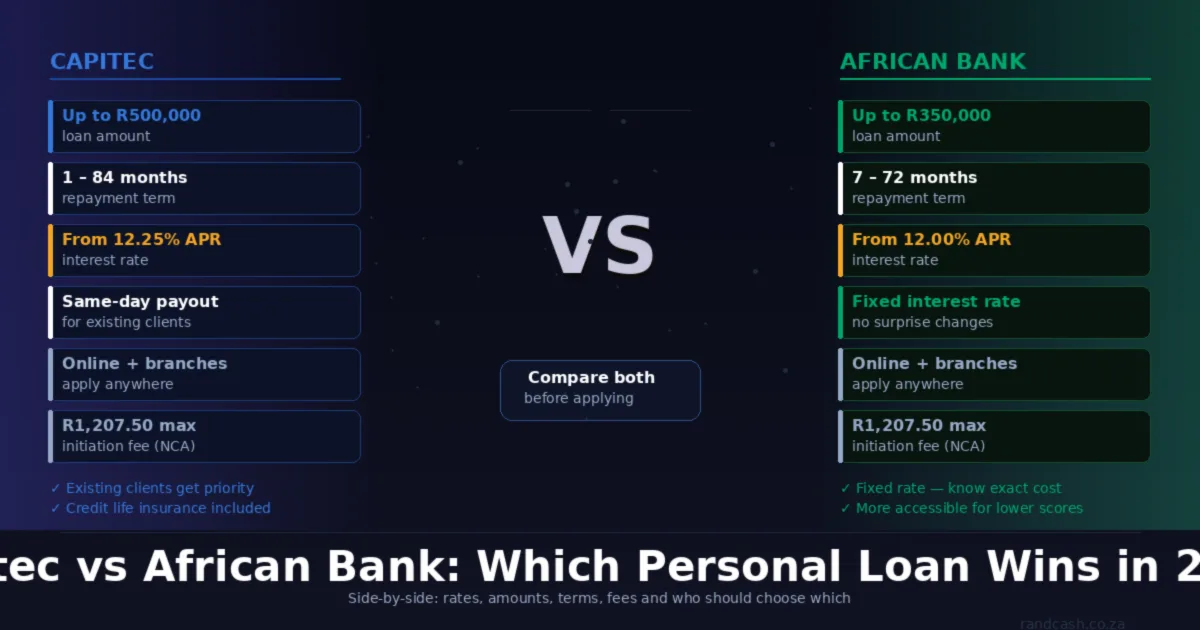
If you are researching personal loans in South Africa in 2026, there is a good chance Capitec and African Bank are both on your list. They should be. Together they account for a significant share of unsecured personal lending in the country, and they are genuinely different products — not just different logos on the same thing. This comparison breaks down what each lender actually offers, where they differ, and which one makes more sense depending on your situation.
Let's start with the numbers that matter most.
| Feature | Capitec | African Bank |
|---|---|---|
| Loan amount | R1,000 – R500,000 | R500 – R350,000 |
| Repayment term | 1 – 84 months | 7 – 72 months |
| Interest rate (from) | 12.25% APR | 12.00% APR |
| Rate type | Fixed | Fixed |
| Monthly service fee | R69 (NCA regulated) | R69 (NCA regulated) |
| Initiation fee | Up to R1,207.50 | Up to R1,207.50 |
| NCA interest cap | 34.85% APR | 34.85% APR |
| Credit life insurance | Included | Included |
| Decision speed | Same day (existing clients) | Same day online |
| Apply via | App / branch / online | Online / branch |
The fees — initiation and monthly service charge — are identical because they are both set by the National Credit Act. Any NCR-registered lender in South Africa must stay within these caps, so this is not a differentiator. The real differences are in the interest rate floor, the maximum loan amount, the maximum term, and how each lender treats different borrower profiles.
On interest rate: African Bank's advertised starting rate of 12% APR is marginally lower than Capitec's 12.25%. In practice, neither rate is available to most applicants — these are the best-case figures for the lowest-risk borrowers. Your actual rate depends on your credit score, income, existing debt commitments, and how long you have been a client. Both lenders will personalise your rate within the NCA-regulated range. The difference in headline rates is real but small. A 0.25% difference on a R50,000 loan over 36 months works out to roughly R400 total — meaningful but not decisive on its own.
On fixed rates: Both lenders now offer fixed-rate personal loans, which means your repayment amount does not change if interest rates move. This is important in the current environment — the SARB raised the repo rate in May 2026 — and it means you can budget precisely from month one. African Bank has historically emphasised fixed rates as a product feature; Capitec has also moved toward fixed terms on personal loans.
On loan amount: If you need more than R350,000, Capitec is your only option between these two. Capitec's ceiling of R500,000 is higher, and their maximum term of 84 months (7 years) is longer than African Bank's 72 months. For larger amounts over longer periods, Capitec has the structural advantage.
Who should choose Capitec?
If you already bank with Capitec, the process is substantially faster. Existing clients can get approval and disbursement on the same day through the app, with no branch visit required. Capitec also has the edge if you need more than R350,000, or if you want a term longer than 72 months to keep your monthly repayment manageable. In 2026, Capitec has tightened its lending criteria somewhat following higher credit losses, so approval is not guaranteed — but for existing clients with a solid repayment history, it remains one of the more streamlined experiences in the market.
Who should choose African Bank?
If you do not have a Capitec account and do not want to open one just to apply, African Bank is the more accessible option. They have been known to approve borrowers who may not qualify through a major bank, though this has been evolving as the market tightens. African Bank's fixed-rate structure is transparent and the quote you get online reflects what you will actually pay. If you are comparing on rate alone and you have a strong credit profile, the 0.25% difference in starting APR tips slightly in African Bank's favour. Their online application process is straightforward and does not require you to hold a transactional account with them.
The honest answer is that for most South African borrowers, the difference between these two lenders is not dramatic. Both are NCR-registered, both are established institutions, and both operate within the same legal framework. The fees are the same. The rate difference is marginal. The more significant factor is often your existing relationship with the bank and your specific credit profile at the time of application.
The right approach is to get a quote from both — not just check the advertised rates. Both lenders offer online quotes without immediately affecting your credit score (a soft inquiry). The quote you receive will reflect your actual risk profile and give you a real number to compare. If one comes back at 19% and the other at 24%, that is a meaningful difference worth acting on. If both come back within a percentage point of each other, the decision can come down to convenience.
One more thing worth noting: in 2026, with prime at 10.50% and affordability under pressure across the board, both lenders are approving fewer borderline applications than they did in 2023 or 2024. If you are declined by one, it does not necessarily mean you will be declined by both — each lender has its own internal risk model. It does, however, mean you should check your credit report before applying, understand what is on it, and address anything incorrect before submitting.
See our guide on how credit scores work in South Africa, or use our lender comparison page to see all 26 NCR-registered lenders on RandCash side by side.
— Romans