
On this page (7)
- 1.What "bad credit" actually means in South Africa
- 2.Atlas Finance: the affordability argument
- 3.African Bank: broader than the big banks
- 4.FASTA: bank statements over credit bureaus
- 5.What every lender will check — regardless of credit score
- 6.How to maximise your chances with bad credit
- 7.The scam to avoid
A low credit score does not automatically close every lending door in South Africa. It narrows your options, raises your rate, and changes which lenders will seriously consider you — but it doesn't end the conversation. This guide explains exactly what "bad credit" means here, which NCR-registered lenders use affordability rather than score as their primary filter, and how to give yourself the best realistic shot at approval in 2026.
This article is for people with a low credit score — broadly, a score under 583 on the TransUnion scale, or equivalent on Experian or Compuscan. It is a different situation from being formally blacklisted (meaning a judgment has been entered against you, or you are in debt review or administration). If you are blacklisted, see our separate guide on loans for blacklisted South Africans. The options, processes, and implications are meaningfully different.
What "bad credit" actually means in South Africa
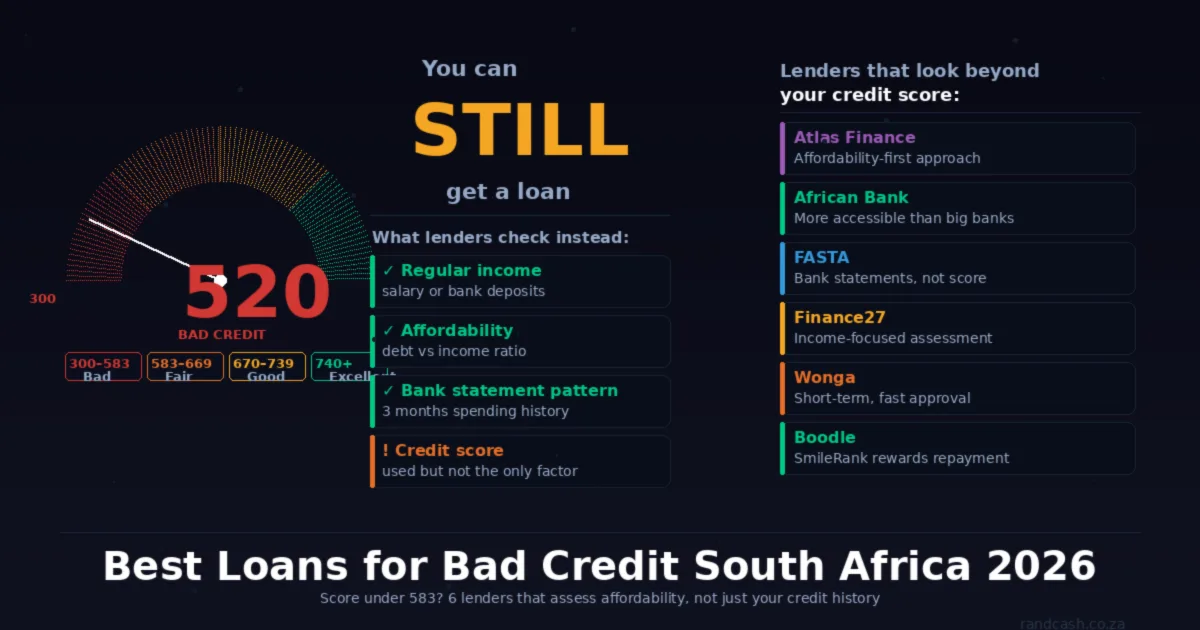
South African credit bureaus — TransUnion, Experian, Compuscan, and XDS — each use slightly different scoring models, but the broad bands are consistent. A score below 583 (TransUnion) or equivalent is typically classified as "poor" or "bad credit." This can result from missed or late payments, high credit utilisation (using most of your available credit limit), multiple credit applications in a short period, or simply having a thin credit file with little borrowing history.
A bad credit score is not a permanent state. It reflects your recent and historical borrowing behaviour, weighted more heavily toward the past 12–24 months. Consistently making payments on time — even small ones — begins to improve your score within a few months.
The practical effect of a bad credit score in 2026 is that the major banks — Absa, FNB, Standard Bank, Nedbank — become very difficult to access. Their credit models weight bureau score heavily, and approval rates drop sharply below 600. Capitec has tightened its criteria in 2026 following higher credit losses. You are not excluded from all credit, but your realistic pool of lenders shrinks to those who explicitly use affordability as their primary filter.
| Lender | Approach to bad credit | Amount | Rate |
|---|---|---|---|
| Atlas Finance | Affordability-first; fixed rate regardless of credit history | R500 – R20,000 | Fixed, personalised |
| African Bank | More accessible than big banks; considers broader profile | R500 – R350,000 | From 12% APR |
| FASTA | Uses bank statements via Open Banking; minimal bureau reliance | R150 – R8,000 | Short-term rates |
| Finance27 | Income and bank statement assessment; bad credit considered | R500 – R8,000 | Short-term rates |
| Wonga | Short-term focus; considers bank statement income, not only score | R500 – R8,000 | Up to 60% APR |
| Boodle | SmileRank builds over time; each repayment improves your standing | R500 – R8,000 | Up to 60% APR |
Atlas Finance: the affordability argument
Atlas Finance explicitly states that they assess affordability rather than using credit score as the primary filter. They offer a fixed interest rate regardless of your credit history — which means the rate you're quoted is not punished by a poor score in the way some lenders do. Their loan range goes up to R20,000, which is higher than most short-term lenders, and they operate both online and through a large branch network across South Africa. For borrowers with a low score but demonstrable regular income, Atlas Finance is consistently one of the more realistic options.
African Bank: broader than the big banks
African Bank occupies a different position in the market than the four major banks. They have historically served a wider credit profile and are more likely to approve applications from borrowers with scores that would be declined by Absa or FNB. Their rates start from 12% APR for the strongest profiles but move higher for riskier borrowers, up to the NCA-regulated cap of 34.85%. For larger amounts (above R20,000) when you have bad credit, African Bank is one of the few realistic routes outside the major banks.
FASTA: bank statements over credit bureaus
FASTA's model is worth understanding. They use Open Banking — real-time access to your transaction data with your permission — to assess your income and spending pattern directly, rather than relying heavily on a bureau score. If your score is low because of historical missed payments but you currently have stable income depositing regularly, FASTA's model may treat you more favourably than a bureau-reliant lender. The trade-off is that FASTA is a short-term, smaller-amount product (up to R8,000), and it works most smoothly for Capitec account holders.
What every lender will check — regardless of credit score
Even the most accessible lenders in this list are legally required by the National Credit Act to perform an affordability assessment. This is not optional or advisory — it is a legal obligation. What they are assessing is whether you can realistically repay the loan without being placed in further financial distress. The factors they look at:
Your gross and net monthly income (from payslip or bank statements), your existing monthly debt repayments, your basic living expenses, the proposed new repayment amount, and whether adding the new repayment leaves you with enough to cover essentials. A lender who approves you without doing this assessment is either not NCR-registered or is operating outside the law — both are warning signs to walk away from.
How to maximise your chances with bad credit
The single most effective thing you can do before applying is to pull your own credit report. TransUnion, Experian, Compuscan, and XDS are all required by law to provide you with one free report per year. Read it. Errors on credit reports are not uncommon — an incorrectly reported missed payment, or a closed account showing as open, can be dragging your score down. Dispute any inaccuracies through the bureau's formal dispute process before you apply.
Beyond that: apply to one lender at a time, not several simultaneously. Each hard inquiry lowers your score slightly and multiple applications in a short window signal desperation to lenders. Choose the lender most likely to approve you based on your profile, apply there first, and wait for a decision before moving to the next.
Reduce your existing credit utilisation where possible before applying. If you have a credit card at 90% of its limit, paying it down to 50% can improve your score noticeably within a month. Even a small improvement can move you from "declined" to "approved at higher rate" with some lenders.
The scam to avoid
In 2026, there is a persistent category of fraud targeting people with bad credit: "guaranteed approval" loans, often advertised on social media and WhatsApp, that require an upfront "insurance fee" or "processing fee" before the funds are released. No legitimate NCR-registered lender operates this way. Fees are deducted from the loan amount, not paid before disbursement. If any lender or broker asks you to pay money before receiving your loan, stop the process immediately and do not transfer any funds.
Verify every lender's NCR registration number at nca.org.za before sharing your ID or banking details. This takes two minutes and eliminates the category of risk entirely.
Bad credit is a constraint, not a dead end. The lenders listed above are genuine, NCR-registered options for borrowers with low scores who can demonstrate stable income and manageable affordability. Expect higher rates than you would receive with a good score — that is the cost of risk — and use any loan you do access as an opportunity to rebuild your record through consistent on-time repayments.
Also read: Loans for blacklisted South Africans if your situation involves a formal judgment or debt review. For a broader overview of your options, compare all 26 NCR-registered lenders on RandCash.
— Romans