
On this page (7)
- 1.Why this year in particular
- 2.Cost one: the tax, which is worse than people expect
- 3.Cost two: the compounding you will never get back
- 4.Cost three: the habit
- 5.When withdrawing to pay debt is genuinely the right call
- 6.When it is a bad idea, plainly
- 7.The comparison worth running before you submit the claim
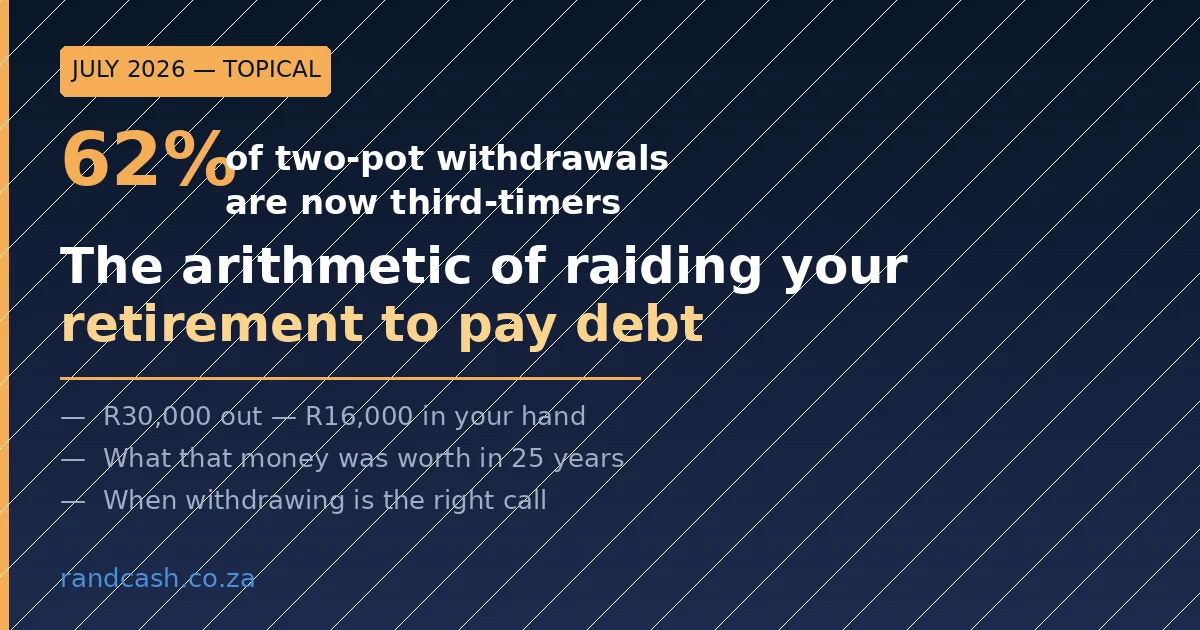
A number came out of the retirement fund data this year that should have got more attention than it did. Of the two-pot withdrawal claims submitted since 1 March 2026 — the start of the current tax year — only 5% came from first-time claimants. Thirty-three percent were people making a second withdrawal. Sixty-two percent were on their third.
Three years in, and the majority of people using the savings pot are using it every single year. Old Mutual’s member research puts it plainly: close to 80% of those who withdrew last year intend to do it again. Total withdrawals since the system opened have passed R60 billion.
The reasons people give, in order: debt consolidation, school fees, basic living costs.
That is not a retirement story. It is a household debt story wearing a retirement costume, and the reason it belongs on a site about credit is that a large share of that R60 billion is being used to pay lenders. If you are considering doing the same before the end of February, the arithmetic below is the part nobody puts in front of you.
Why this year in particular
The pressure is real and it is not imagined. Roughly 40% of credit-active South Africans are in default on at least one account — three months or more in arrears. Overdue balances grew by about R12 billion in the final quarter of 2025 alone.
And rates have not come to the rescue. The Reserve Bank held the repo rate at 7% on 23 July, leaving prime at 10.5%, after having hiked at the previous meeting. Inflation moved the wrong way in June, up to 5% from 4.5% in May, and the Monetary Policy Committee split four-to-two, with two members wanting a further increase. Nobody on that committee is signalling relief.
So: households squeezed, arrears climbing, borrowing costs not falling, and one accessible pot of money sitting in a retirement fund. It is entirely rational that people are reaching for it. The question is whether the specific thing you are about to pay off justifies what the withdrawal costs you, because that cost is much larger than most people realise and it arrives in three separate pieces.
Cost one: the tax, which is worse than people expect
This is where most of the damage happens, and it happens because of a widespread misunderstanding.
A savings pot withdrawal is not taxed under the retirement lump sum tables. There is no R25,000 tax-free portion. The withdrawal is added to your taxable income for the year and taxed at your marginal rate — the same rate as your salary. Your fund administrator applies to SARS for a tax directive, and the tax is deducted before the money reaches your account.
Which means the amount you asked for is not the amount you get.
Withdraw R30,000 on a 45% marginal rate and you receive roughly R16,000 after tax and fees. Fourteen thousand rand of your retirement savings went to SARS and the administrator, and it is not coming back. On a 31% marginal rate the same R30,000 nets you around R20,500. Even on 26% you are losing close to R8,000.
Two more things that catch people. A large withdrawal can push you into a higher bracket, so the effective rate on the withdrawal is worse than the rate you think you are on. And if you have outstanding returns or a tax debt, SARS will instruct the administrator to deduct that too under an IT88 — people have submitted a withdrawal expecting R18,000 and received a fraction of it because an old tax debt was settled out of it first.
The administration fee is around R250, which is trivial next to the tax but worth knowing about.
Cost two: the compounding you will never get back
The R14,000 that went to SARS is the visible loss. The invisible one is larger.
Take that R30,000 and leave it invested for 25 years at a 10% nominal return. It becomes roughly R325,000. Over 15 years, around R125,000.
I want to be honest about that figure rather than use it as a scare tactic, because personal finance writing abuses it constantly. That R325,000 is in future rands, and inflation will have eaten a lot of it. In today’s purchasing power, at around 4% inflation, R30,000 compounding for 25 years is worth something closer to R120,000 — four times what you withdrew, in real terms, not eleven times.
Four times is still the correct comparison, and it is still a lot. It means that withdrawing R30,000 to receive R16,000 is trading roughly R120,000 of real future money for R16,000 of cash today. That is a legitimate trade in some circumstances. It is a catastrophic one in others. The difference is entirely what you do with the R16,000.
Cost three: the habit
This is the part the 62% figure is actually telling us, and it is the reason the two-pot data has started worrying people who watch this professionally.
The savings pot was designed as an emergency valve. What the withdrawal pattern shows is that a large group of people have converted it into an annual event — a second thirteenth cheque, drawn every year in roughly the same month, for roughly the same reasons.
A one-off withdrawal to clear a genuine crisis is a defensible decision. An annual withdrawal to service ongoing debt is not a solution to anything; it is a subsidy that allows an unaffordable debt structure to keep running one more year. The debt does not shrink. The retirement fund does. And each year the withdrawal is a little less effective, because the underlying problem was never addressed.
If this is your third withdrawal and the reason is the same as it was the first time, the withdrawal is not the intervention you need.
When withdrawing to pay debt is genuinely the right call
I am not going to pretend the answer is always no. There are situations where the arithmetic clearly favours the withdrawal, and they share one feature: the debt you are clearing is more expensive than the compounding you are giving up.
Informal lender debt. A mashonisa loan compounding at 30% to 50% a month, with no amortisation and no end date, destroys wealth faster than any retirement fund builds it. Clearing that with a withdrawal is not a close call. Do it, and do it before the charge rolls over again.
Short-term credit rolling over repeatedly. Payday-type credit at the NCA cap works out around 60% a year on a first loan. If you have been rolling the same R6,000 for eight months, you are paying more in charges than the withdrawal costs you in tax. Settle it.
A debt about to become a judgment. A judgment sits on your credit record for five years and can lead to an attachment order against your salary. If a withdrawal settles the account before summons, you are buying five years of credit access for the cost of the tax. That is usually worth it.
Arrears about to trigger a default listing. Same logic on a smaller scale. A default listing is five years of restricted, expensive credit. Curing arrears before the listing goes on is a high-return use of the money.
When it is a bad idea, plainly
To pay your bond. Your home loan is sitting somewhere near prime, currently 10.5%. Your retirement fund should be doing better than that over any long horizon, and the withdrawal costs you 26% to 45% in tax before a single rand reaches the bond. The maths does not work. Overpay the bond from income instead if you can.
To cover ordinary living costs. This one is difficult to say to someone with an empty fridge, and I am not going to be glib about it. But a withdrawal that funds three months of groceries leaves you in exactly the same position in month four, minus the tax and minus the compounding. If living costs are the reason, the problem is the budget or the income, and the withdrawal delays confronting it by one quarter.
To consolidate debt you could restructure instead. This is the biggest one, and it is the single most common stated reason for withdrawing. If the plan is to use the withdrawal to consolidate several accounts, compare it honestly against a consolidation loan first. A consolidation loan at 18% a year costs you interest. A withdrawal costs you 31% of the capital immediately plus the compounding forever. There are cases where the loan is cheaper than the withdrawal, and most people never run that comparison because the withdrawal feels free — it is your own money, after all. It is not free. It is the most expensive money you own.
Because it is available and February is coming. The one-withdrawal-per-tax-year rule creates artificial urgency, and people withdraw in February purely to avoid “wasting” the allowance. There is no allowance to waste. Money left in the fund is not forfeited — it is working.
The comparison worth running before you submit the claim
Write down two numbers.
First, the total annual cost of the debt you want to clear. Not the monthly payment — the actual interest and fees you will pay on it over the next twelve months if you do nothing.
Second, the tax you will pay on the withdrawal. Your marginal rate multiplied by the gross amount you plan to take.
If the first number is bigger than the second, the withdrawal is probably the right decision and you should stop deliberating. If the second is bigger, you are paying SARS more than the lender was charging you, and there is almost certainly a better route — a consolidation loan, a negotiated payment arrangement with the creditor, or a debt counsellor if the obligations genuinely exceed what you earn.
Two numbers. Ten minutes. It is the highest-return calculation available to anyone considering this before February, and the reason to do it now rather than in the last week of the tax year is that you will make a better decision without a deadline pressing on you.
— Romans
This is general information, not financial advice, and I am not a licensed financial adviser. Withdrawal decisions interact with your tax position and your retirement planning in ways that are specific to you — a registered financial adviser or your fund’s retirement benefits counsellor can model your actual numbers, usually at no cost through your fund.